


I was “volunteered” for this UV+EB Technology column journey in 2019. This column (number 30) is close to the same number of years I have been involved with UV technology. I still learn every day and get excited about new applications, while not forgetting the basic building blocks of UV, measurement and process control.
This column will focus on the “ABCs” of UV measurement and process control. The goal is to help newcomers and to provide a review for those with experience. The letter “A” is covered in this column, and the pace will pick up as we work our way through the alphabet.
 When I was young, Captain Kangaroo taught the ABCs using “A” for Apple, “B” for Ball, “C” for Cat and “D” for Dog. Today, kids have multiple ways to learn that “A” is for Artificial Intelligence, “B” is for Bluetooth, “C” is for ChatGPT and “D” is for Download.
ABC Ground Rules
- Will the UV ABCs listed cover every UV term? No. The focus will be on terms related to UV measurement and process control; the ones that we at EIT 2.0 explain most often. Where possible, I will use real-world examples and graphics.
- I encourage the formulators/chemists reading this column to develop their own “ABC” list from a formulation/chemistry perspective to use for education.
- Will I take poetic license with some of the terms to have at least something for every letter? Absolutely.
- Will the terms listed be checked for “correctness” by the RadTech Editorial Board? Absolutely. In the end, any mistakes are my responsibility. The RadTech Editorial Board is an important volunteer group, which I hear is more fun than sitting on a Homeowners Association (HOA) board.
- Twenty-one years ago, the RadTech Measurement Group developed and released a Glossary of Terms for Ultraviolet (UV) Curing, Process Design and Measurement. It is posted on the RadTech website at https://radtech.org/uv-glossary/ and remains a great reference.
- In the real world, different words (“Energy Density” and “Dose”) sometimes are used for the same thing. I will try to follow the RadTech glossary, but make sure you are communicating within your company and with your suppliers in the same “UV language.”
Absolute Values
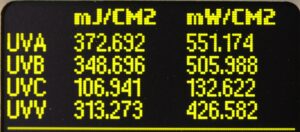
Absolute values are “calibrated” numerical values, most often in Joules/cm2 and Watts/cm2 (Figure 1). They provide numerical values and allow:
- communication within a facility, between facilities and with formulators and UV source suppliers;
- starting points to match a specification on a technical data sheet;
- users to establish, optimize and maintain a process window;
- comparisons between multiple lines and equipment brands; and
- troubleshooting when there are issues.
Practical Tip
With absolute data, decide within your company how data will be collected, reported and organized. Agree on the units to be reported (J/cm2/W/cm2 or mJ/cm2/mW/cm2) and the units used. Establish radiometer settings. We strongly suggest recording both watt and joule values. Be sure to communicate in the same radiometric language to avoid “apples to oranges” comparisons. See the discussion about Bandwidth in a future column. Looking for changes in UV over time and comparing the change to itself is another measurement strategy. See the discussion under Relative Values, appearing in a later column.
Additive Lamps
Also called “doped,” “halide” or “special fill” lamps/bulbs, additive lamps are medium-pressure mercury (arc or microwave) lamps that have small amounts of metal halides added to the mercury within the bulb. The additives emit their characteristic wavelengths in addition to the wavelengths emitted by mercury. Common additives include iron and gallium.
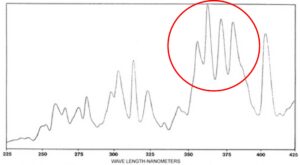
- Mercury-iron bulbs commonly are referred to as “D” bulbs and have increased output between 350 and 400 nm (Figure 2).
- Mercury-gallium bulbs commonly are referred to as “V” bulbs and have increased output in the 400-450 nm range. The longer wavelengths from a “V” lamp can better penetrate through coatings and often are used with opaque and white coatings.
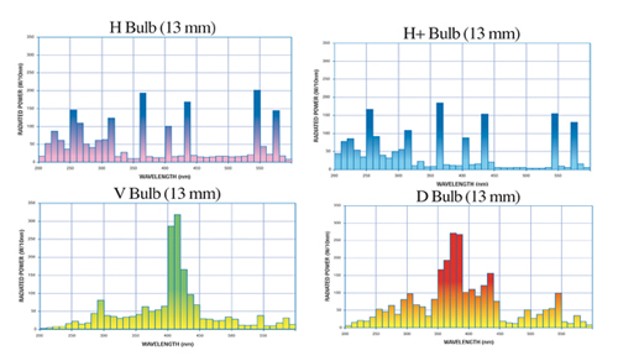
Lamp manufacturers provide information on the spectral output of their various lamps in different formats, ranging from continuous output to a graphic with output grouped or banded in 5-10 nm bands (Figure 3).
Practical Tips
- Check with your lamp/bulb suppliers, as they may use different nomenclature to describe their additive lamps. “FE” (iron) sometimes is used instead of “D” for a mercury-iron bulb and “GA” (gallium) instead of “V” for mercury-gallium bulbs. Do not let the purchasing team order the wrong bulb.
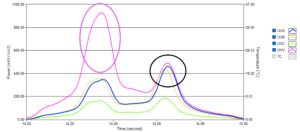
- The bulb type can be determined easily with a multi-band radiometer (Figures 4 and 5).
- If using a profiler-enabled radiometer, look at the ratio of bands on the irradiance profile.
-
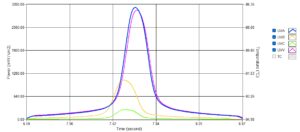
Figure 5. Irradiance profile of a “D” (mercury-iron) bulb showing the UV-A and UV-V values higher than the UV-B values. If a profiler isn’t available, compare the ratio of the numerical watt values between bands.
Numerical Value Comparison
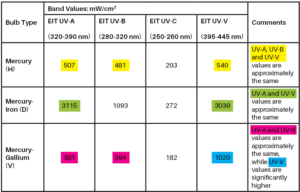
The ratio of the UV-A, UV-B, UV-C and UV-V band values in Table 1 shows the differences between mercury, mercury-iron and mercury-gallium sources. Values are in milliWatts with the band values defined. The bulbs are of different source types. Comparisons should only be made with the other bands of a particular bulb. The ratios may vary based on the bandwidth of other instruments and the bulb supplier.
Application
The type of application and process window often dictates the measurement and process control strategy and what may or may not work. Questions that we ask include:
- What type of UV source (broadband, LED) is used in the process?
- For a broadband source, what type (mercury, mercury-iron, mercury-gallium) of bulb is used?
- For an LED, what is the wavelength range in nanometers (nm)?
- What is the expected output in W/cm2 of the source? This will help to identify the correct dynamic-range instrument.
- How many sources? If there are multiple sources, would a profiler radiometer that can show each source be better?
- How much space is available in the process to either pass a radiometer under the source or mount a sensor? This may be a limiting factor and drive the measurement strategy.
- How fast is the process running? Is a radiometer with a faster sample rate needed?
- Are there important properties or characteristics in the cured coating to monitor? An example would be monitoring the shortwave UV-C if surface-cure properties, such as scratch or stain resistance, are important.
- Do you have a product that needs more frequent or continuous monitoring? Examples could include high-value products, medical-related products, fast production speeds or customer requirements to monitor each lot of products produced.
Summary
Please feel free to provide feedback to me on UV-related terms that should be included in future columns. Keep in mind that by the time you read this column, the next column already has been submitted for review.
Parting Shot
For those of you who learned your ABCs on a black and white TV from Captain Kangaroo, the ABCs you need to be concerned about are A: Arthritis; B: Blood pressure; C: Cholesterol and D: Diabetes.
 Jim Raymont
Director of Sales
EIT 2.0 LLC
jraymont@eit20.com