
In the 1st Quarter, 2023 edition of “Professor’s Corner,” we discussed the reaction kinetics of free radical UV polymerization. 1 In this edition, we will discuss the kinetics of cationic UV polymerization. Both processes involve “chain-growth” polymerization, but they differ significantly in the raw materials used and the reaction conditions employed.
Introduction
Kinetics involves studying the rate, or “speed,” of polymerization reactions and the factors that influence it. 2 This type of study leads to developing proposed reaction mechanisms that explain how reactants turn into products at the molecular level. However, it is important to remember that reaction mechanisms are formal hypotheses that can be shown to be incorrect through further testing. They can be disproven but never definitively proven in the traditional sense.
Free Radical UV Polymerization involves the use of photoinitiators that absorb light from the lamp source. This kicks the photoinitiator into a higher-energy state, known as an “excited state.” This excited state then loses excess energy via molecular rearrangements that, in turn, generate free radicals. Free radicals are molecular species containing highly reactive unpaired electrons that initiate polymerization, typically by reaction with monomers and oligomers containing ethylenically unsaturated double bonds, such as acrylates, methacrylates or certain vinyls.
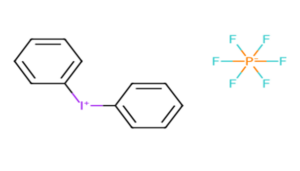
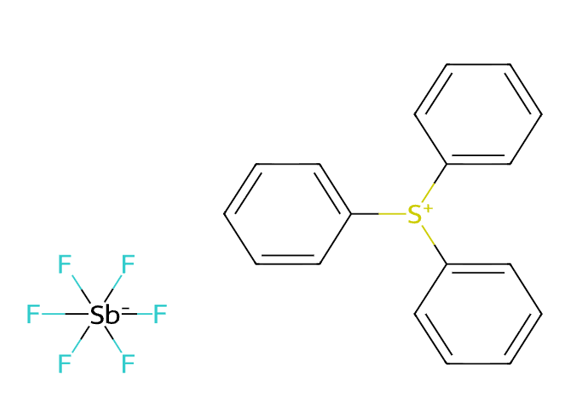
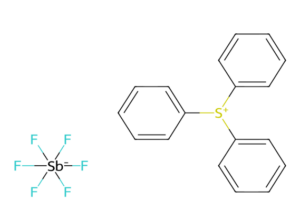
Cationic UV Polymerization photoinitiators, as their name implies, produce cations (either hydrogen ions or carbocations) that subsequently initiate the polymerization. 3 These photoinitiators usually are onium salts of iodine and sulfur. They have two or three phenyl groups attached to the iodine or sulfur atoms, respectively, as shown in Figures 1 and 2. These phenyl groups provide the chromophore that absorbs the UV energy through the promotion of electrons in bonding molecular orbitals to antibonding molecular orbitals: p -> p*.
This action creates an excited state. To dissipate the excess energy, the excited electron cleaves the s-bond between one of the aromatic benzene rings and the iodine or the sulfur atom. This, then, produces a radical ion on the heteroatom and a free radical on the separated aromatic ring. This reaction is depicted in Reaction 1. In a subsequent reaction, the iodonium radical abstracts a hydrogen atom from an alcohol, an ether, a polymer fragment or another hydrogen-containing species (R-H) to produce the strong acid required for polymerization (Reaction 2). Reaction 3 depicts the strong acid initiating the polymerization of a vinyl ether. However, if no hydrogen-containing material is present, the radical cation, ArI+can initiate polymerization. Reaction 4 shows the first step in the propagation phase of the vinyl ether polymerization.
These photoinitiators, being ionic salts, also contain a counter-ion that is important in the polymerization process. These anions usually are SbF6–, PF6– or BF4–. They are relatively large anions with a single charge, resulting in a low charge density. This makes them non-nucleophilic so that they do not bind tightly to the cation. Nucleophilic anions would be strongly attracted to the cation, leading to a cessation of the polymerization reaction. The larger the counter-ion, the lower the charge density, and the faster the polymerization reaction will occur. This is because a higher charge density produces a stronger attraction to the cation, increasing the likelihood of interference with the propagation phase of the polymerization reaction while providing the formulator with some control over the expected reaction rates.
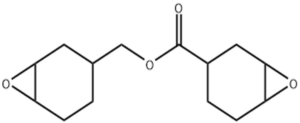
 Cationic UV-Polymerizable Monomers include epoxides, particularly cycloaliphatic epoxides, and vinyl ethers. Perhaps the most important monomer for cationic UV polymerization is 3,4-epoxycyclohexyl-methyl-3’,4’-epoxycyclohexane carboxylate (Figure 3). 6 This polymerizes by a ring-opening mechanism.
 Cationic Polymerization Kinetics
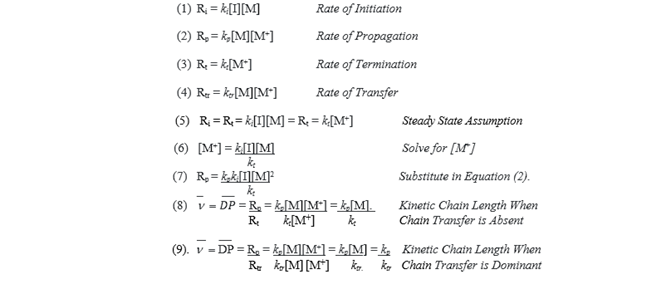
While both free radical and cationic UV polymerization are chain-growth processes, the cationic UV polymer systems behave differently because the active species is an ion (a positive charge) rather than a neutral radical. Therefore, termination by combination isn’t possible. However, this situation presents a distinct advantage for the cationic polymerization process, as it allows the polymerization to continue even after the UV lamp is turned off. Thus, it tends to give a more complete cure. Equations 1-4 depict the rates of the various steps in the cationic polymerization process. 7 As with the free radical UV polymerization mechanism, one can make a “steady state” assumption that the rate of initiation is equal to the rate of termination, Ri = Rt as shown in Equation 5. This allows for calculating the concentration of active cations at the ends of growing polymer chains, [M+], as is shown in Equation 6. From that, the rate of polymerization, Rp, is calculated in terms of the monomer and photoinitiator concentrations, as shown in Equation 7. This equation shows that the polymerization rate is highly dependent on both monomer and photoinitiator concentrations, in the absence of chain transfer. This leads to Equation 8, which shows that the kinetic chain length, or average degree of polymerization, depends on the monomer concentration. However, if chain transfer dominates, Equation 9 shows that the kinetic chain length is independent of either the monomer or the photoinitiator concentration.
For Further Study
For those who would like to delve more deeply into the fascinating chemistry of cationic UV polymerization, a quick Google search of “Cationic UV Polymerization” reveals a plethora of articles, patents and other sources.
Technical Questions?
What are your technical questions about polymer science, photopolymerization or other topics concerning the chemistry and technology of UV/EB polymerization? Please submit your questions or comments via e-mail to Dianna Brodine, vice president, editorial for Peterson Media Group, at dianna@petersonmg.com or to me at b4christmas@gmail.com.
 Byron K. Christmas, Ph.D.
Professor of Chemistry, Emeritus
University of Houston-Downtown
b4christmas@gmail.com
References
- Christmas, Byron, “Professor’s Corner”, UV+EB Technology, Vol. 9, No. 1, pp. 16-17.
- , pg. 16.
- Christmas, B. K. & Idacavage, M. J., Photopolymerization: Fundamental Polymer Chemistry & Industrial Applications, DEStech Publications, Inc., 2023, pp. 60-61.
- CSID:2018781, https://www.chemspider.com/Chemical-Structure.2018781.html, (accessed 16:04, Mar 15, 2026).
- CSID:10607044, https://www.chemspider.com/Chemical-Structure.10607044.html, (accessed 16:00, Mar. 15, 2026).
- Christmas, B.K. & Idacavage, M. J., op. cit., pp. 123-132.
- , pp. 63-64.