
By Michael Bonner, vice president of engineering & technology, St. Clair Systems
According to the National Business Aviation Association (NBAA), “AAM is a new concept of air transportation using electric vertical takeoff and landing (eVTOL) aircraft to move people and cargo between places not currently or easily served by surface transportation or existing aviation modes. eVTOL aircraft may be powered by hybrid electric systems, batteries or potentially hydrogen fuel cells.” 1
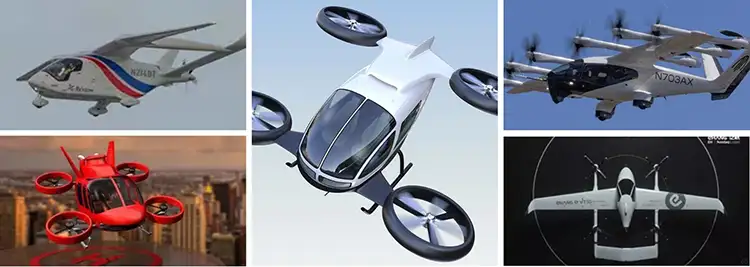
Initially, the industry called this technology Urban Air Mobility (UAM), but in March of 2020, NASA labeled the nascent industry as Advanced Air Mobility (AAM), a term that widely is accepted today as a better and more inclusive fit than UAM. The concept takes many forms, some of which are shown in Figure 1.
This new category of air transportation often is referred to as the “Low Atmosphere Economy” and, in addition to personal transportation, includes cargo, drones, etc. This introduces a whole new approach to aviation, which brings with it many new opportunities.
AAM Marketplace
In 2024, Airbus produced 766 planes, while Boeing produced just 348 planes – a total of 1,114 commercial aircraft. But the AAM marketplace is going to be strikingly different from the commercial aerospace marketplace. A 2023 report by Aviation Week’s fleet data team forecast that approximately 1,000 units would need to be delivered annually by 2030, 10,000 by 2040 and 30,000 by 2050. While these numbers may seem aggressive, a subsequent July 2024 forecast from that same Aviation Week team increased these projections, calling for nearly 12,000 eVTOL deliveries worldwide by 2040 and 33,000 by 2050. 2 In further support of these forecasts, on December 17, 2025, Joby Aviation, a leader in AAM development, announced it will double its US production capacity, aiming to make four electric aircraft for commercial passenger use per month by 2027. 3
Clearly, this represents a significant opportunity in a new and burgeoning market. As a result, “The Vertical Flight Society counts over 1,000 entrants in the AAM industry, with new ones added on a weekly basis.” 4 To achieve these targets, it will be necessary to significantly adjust existing aerospace regulations as they apply to AAM production.
Regulatory Environment
Existing aerospace regulations have evolved over the last 100 years with one key objective in mind: safety. The goal is to minimize the occurrence, as well as the impact, of any failure in components, processes or procedures. The reason is survivability, which is nearly zero on commercial jets. This has a significant impact when considering that the passenger count on a narrow body jet is between 120 and 230 individuals. For a 747-8, that count climbs to about 600, and for an A380, that number rises to as high as 850. Any incident of this magnitude is going to be a newsworthy event.
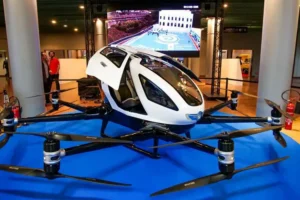
The eVTOL Taxis that are common for AAM are more like automobiles, or more specifically Electric Vehicles (EVs), with a passenger count of one to eight individuals. Automobiles and EVs come with safety systems, such as anti-lock brakes, air bags and collision avoidance systems to improve survivability. As shown in Figure 2, eVTOLs also come equipped with redundant props and motors, redundant electronic systems, collision avoidance systems and even whole-vehicle parachutes for the ultimate fail-safe. All these factors combine to address the strict regulatory requirements for AAM systems without reducing the safety and survivability of these systems.
This clearly is one of the objectives of the Trump administration. On September 12, 2025, US Department of Transportation (DOT) Secretary Sean P. Duffy announced a new pilot program within the Federal Aviation Administration (FAA) to accelerate the deployment of AAM vehicles. Established under Executive Order 14307 (June 2025), 5 the pilot program, known as the Electric Vertical Takeoff and Landing Integration Pilot Program (eIPP), will form public-private partnerships with state and local government entities and private sector companies to develop new frameworks and regulations to enable safe operations. 6
According to the non-profit Drone, Aviation and Robotics Technology (DART) organization, the purpose of the eIPP is to reduce regulation and accelerate the deployment of safe and lawful eVTOL and other AAM operations in the United States. It is intended to generate data, lessons learned and policy insights to shape national regulations while demonstrating the viability and benefits of these technologies. The goal is to:
- accelerate safe and efficient integration of eVTOL and other AAM operations into the National Airspace System (NAS);
- generate data to inform FAA regulations, guidance and policies;
- foster public-private partnerships and
- provide opportunities to accelerate commercial operations.
The FAA and DOT are looking for projects that not only demonstrate operations but also produce actionable regulatory and policy insights for scaling AAM nationwide. 7
This is key to the design and manufacturing requirements necessary to support the 10,000–12,000 projected unit volume of eVTOL taxi production.
eVTOL Taxi Design and Manufacturing
In addition to production volumes, the eVTOL Taxi shares many other traits with its EV cousin. Because it is electric, it depends on batteries and all their established issues, including advanced electronic systems, charger availability, charging time, range anxiety, fire avoidance and suppression, battery life, and end-of-life recyclability concerns, to name a few.
As with an EV, in order to be successful, an eVTOL Taxi must be constructed of lightweight materials, such as plastics, composites, aluminum, titanium, etc. Therefore, construction involves joining and coating many dissimilar materials. Installing piercing fasteners (screws, rivets, etc.) is time-consuming and, when dealing with dissimilar materials, often results in joints with compromised strength and lifespan. The solution is to adopt EV production methods, including the use of modern adhesives and sealers.
Production volumes of 10,000-12,000 per year are too high to be supported by commercial airliner production methods, yet too low to support a lot of dedicated tooling, for instance, for the molding of plastic parts. This is where advancements in 3D additive manufacturing enter to bridge the gap.
Energy Cure Materials
UV-cure materials often are referred to as “Energy Cure Technologies.” Energy curing started with Electron Beam (EB) technology, based on work done by Edwin Newton of the B. F. Goodrich Company in the 1920s. He developed a method to “vulcanize” natural rubber using high-energy electrons – a process for which he filed a US Patent in 1929. The use of EB to partially cure tire components still is standard practice in the industry today.
The development of photoinitiators to enable UV curing began in the 1960s, with major commercialization during the 1970s driven by the energy crisis brought on by the 1973 OPEC oil embargo and the resulting limited availability of fossil fuels. Advancements in chemistry over the last 50 years have made an extensive number of options available to formulate coatings, sealers, adhesives and 3D printing materials with a wide variety of cured properties. This has enabled countless industries to exploit the advantages of energy cure technologies in their processes.
Thermal Cure vs. Energy Cure Technologies
Conventional coating, sealing and adhesive technologies employ thermal-cure processes. Thermal cure means that the coating, sealer or adhesive is cured by baking – or bringing it to an elevated temperature – which drives out any solvents and then initiates the cross-linking process. This baking process is performed in an oven, which consumes energy to heat the oven, air, part(s), coating(s), sealer(s), adhesive(s), etc.
Specifically, with organic solvent-borne materials, “driving out solvents” means releasing Volatile Organic Compounds (VOCs) into the air in the oven. The release of VOCs presents a couple of problems. First, the solvent vapors are flammable (volatile), so they must be removed from the oven to prevent an explosion. However, VOCs also are harmful to the planet (and the life on it), so simply releasing them into the atmosphere is not acceptable. The solution is to incinerate the VOCs to remove them from the air stream before they are released into the atmosphere. This incineration usually is performed in a Regenerative (or Recuperative) Thermal Oxidizer (RTO). The RTO takes advantage of the flammability of the solvents in the airstream as a fuel, but it usually is necessary to supplement it with natural gas to ensure that the temperatures in the RTO are high enough to remove the carbons in the exhaust stream. This further exacerbates the energy consumption of the thermal-cure system.
Energy-cure materials, on the other hand, are formulated so that there are no solvents in the blend. The curing/cross-linking process is initiated by exposing the coating either to high-energy electrons or a high-energy light wave – often in the ultraviolet (UV) band. Because this energy is focused directly on the coating, it is more efficient, requiring significantly less energy to perform the curing function – as much as 95% less. Moreover, there are no VOCs to incinerate, so no RTO or other remediation is required to protect the environment.
Advantages of Energy Cure Materials
In addition to the significant reduction in energy consumption and the natural sustainability characteristics since these formulations contain no VOCs, energy curing offers many other advantages to the AAM production environment. These include the following:
- Lower weight: Energy-cure materials offer the same or superior performance as their conventional counterparts with thinner films and cross sections, resulting in reduced weight – a key objective in payload and range metrics.
- Durability: Energy-cure materials often are more durable than their conventional counterparts, providing improved performance.
- Speed: The instantaneous curing of these materials eliminates wait time, resulting in shorter processing cycles and increased throughput.
- First-pass yield: Since full cure is reached instantaneously, handling issues associated with conventional materials (such as scratches, blocking, etc.) are eliminated. This reduces rejects, rework and scrap.
- Footprint: Because large curing ovens are not required, energy-cure systems take up significantly less space than conventional processes.
- Less waste: All these factors, combined with the fact that energy cure materials can be collected and reused, result in a reduced waste stream from the process.
- Clean energy support: The reduction in energy required to power the energy cure process enables the adoption of clean energy alternatives by lowering demand on the grid.
Energy Cure Applications in AAM
All of these advantages combine to make energy cure technologies a solution of great interest in many AAM manufacturing operations. These include the following:
- Protective coatings: Anti-corrosion coatings for structural frame components and drive system components (props, motor housings, etc.), conformal coatings on electronic assemblies, glass coatings and more all can be achieved with thinner, lighter films that provide greater protection properties regardless of the substrate.
- Decorative coatings: Pigmented coatings and clearcoats can be applied to improve appearance on various substrates with thinner, lighter films that also last longer than conventional coating options.
- Graphics: Commercial aircraft basically are flying billboards for their airlines. Thin-film pigmented coatings and clearcoats open the way to multi-color graphics on AAM eVTOL units without compromising weight considerations. These concepts already are being applied to Formula 1 graphic applications.
- Bonding: As noted, joining dissimilar parts without piercing fasteners is key to the reliability, longevity and pace required to support AAM manufacturing. Energy cure adhesives maintain their “positioning consistency” until they are exposed to UV or an electron beam, at which point the bond achieves full strength (or near full strength) instantaneously. This allows for highly accurate, repeatable joints produced at the speed of light.
- Sealing: As with bonding, sealing areas such as passenger compartments, motor housings, battery packs and electronics enclosures, to name a few, is critical to the success of AAM. But the same advantages as bonding apply. The sealer bead profile can be applied with high precision and then immediately cured to maintain the short cycle times critical to this level of manufacturing.
- 3D-printed parts: Additive manufacturing is becoming increasingly well accepted. The 3D printing market is set to reach $50 billion by 2030, with $2.5 billion (~ 5%) of that to be UV. UV 3D printing offers high speed due to instant curing, versatility (as materials with various properties are available) and the ability to print on many materials, including glass, metal, plastic and more. The use of UV curing enables high detail and resolution, and its durability, including scratch and fade resistance, is well established. With no solvents, the process is more environmentally friendly, with few to no VOCs and less waste. Parts can be both functional and aesthetic and made in vibrant colors with textured prints (such as braille) with various resins, reducing post-processing needs. Because the cure is immediate and complete, the parts are available for finishing or subsequent operations without delay.
Conclusion
The industry is on the verge of a significant change in air transportation, heavily promoted by governments at all levels. The unique demands of AAM are opening opportunities for innovative manufacturing solutions. Nowhere is this opportunity greater than for UV and EB processing technologies.
Bibliography
- “Advanced Air Mobility (AAM)”, National Business Aviation Association (NBAA), nbba.org. https://nbaa.org/aircraft-operations/emerging-technologies/advanced-air-mobility-aam/2025.
- Aviation Week Data Team, “Aviation Week Doubles eVTOL Forecast; Expects 2,000 Deliveries By 2030”. https://aviationweek.com/aerospace/advanced-air-mobility/aviation-week-doubles-evtol-forecast-expects-2000-deliveries-2030, July 22, 2024.
- Joby Announces Plans to Double Manufacturing Capacity in United States. https://www.jobyaviation.com/news/joby-announces-plans-to-double-manufacturing-capacity-in-united-states/, December 17, 2025.
- “Advanced Air Mobility Reality Index”, SMG Consulting. https://aamrealityindex.com/aam-reality-index
- The White House, “Unleashing American Drone Dominance”, https://www.whitehouse.gov/presidential-actions/2025/06/unleashing-american-drone-dominance/, June 06, 2025.
- Federal Aviation Administration, “Trump’s Transportation Secretary Sean P. Duffy Unveils New Plan to Fast-Track Advanced Air Mobility Vehicles”, https://www.faa.gov/newsroom/trumps-transportation-secretary-sean-p-duffy-unveils-new-plan-fast-track-advanced-air, September 12, 2025.
- Drone, Aviation, and Robotics Technology (DART), “eVTOL Integration Pilot Program (eIPP)”, https://mbdart.org/eipp/, September 22, 2025.
 Michael Bonner is the vice president of engineering and technology for Saint Clair Systems, Inc., a leading supplier of process temperature and viscosity control equipment for industrial fluid dispensing systems. A degreed electrical engineer, over the years, he has spent time in a wide variety of industries including audio systems, medical equipment, HVAC and appliance controls, metal stamping and even the manufacture of gasoline pumps. For nearly 30 years, however, Bonner has focused on the science of point-of-use temperature and viscosity control in fluid dispensing processes. For more information, email mbonner@viscosity.com or visit www.viscosity.com.