


How do new chemicals get a SNUR? What is a SNUR? And how do companies work with a SNUR?
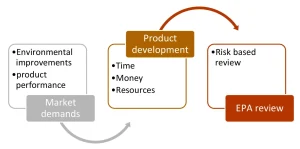
Manufacturers are creating new chemicals to keep up with the performance and environmental demands customer’s desire. There are many hurdles to overcome when bringing a better chemical to market – not to mention the amount of time, money and resources needed for development. Once the development is complete, the information is submitted to the US Environmental Protection Agency (EPA) for review (Figure 1).
Why do new chemicals need to be submitted to the EPA?
All imported or manufactured chemicals must be on the Toxic Substances Control Act (TSCA) inventory list or qualify for an appropriate exemption. New chemicals not on the TSCA inventory list must have a risk-based review by the EPA.
If the EPA determines a new chemical “may” or “does” present an unreasonable risk of injury to health or the environment, EPA may issue a SNUR to the submitter.
What is a SNUR?
SNUR stands for Significant New Use Rule. A SNUR is a tool used by EPA to allow chemicals into commerce with restrictions that address EPA usage concerns.
What type of restrictions are there?
A SNUR regulates the use, handling and recordkeeping of the new chemical, such as Hazard Communication Standards (HAZCOM), Personal Protective Equipment (PPE) and release to water.
Has the chemical approval process changed? It seems so difficult.
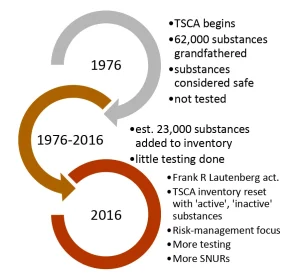
In 1976, TSCA was created to regulate toxic chemicals in commerce. At that time, 62,000 chemicals were grandfathered into the TSCA inventory. Forty years later, TSCA was updated. As a result of the update, the focus is risk-management based and SNURs are common (Figure 2).
Why should a new material be considered if users must do more compliance?
The easy route is to use existing materials and forgo innovation and SNURs at the expense of not meeting end user growing demand for better performing products.
However, the regulatory environment has changed in recent years. TSCA has been updated in 2016. Since 2016, about 38% of all new chemicals received a SNUR; prior to 2016, it was only 10 to 15%. The chances of working with a SNUR are getting higher.
Working with a SNUR
Recall that a SNUR’s focus is to manage risk to health and environment; therefore, the requirements to follow a SNUR more than likely will be found within a company’s established EH&S program, such as HAZCOM, PPE and recordkeeping.
- Copies of the SNUR must be provided to the end user of the chemical.
- Read over the SNUR requirements – all SNURs are not equal. Some have few requirements; others many.
- Compare the EH&S program in place at the manufacturing facility to the SNUR requirements.
- Chemical industries are regulated heavily by local, state and federal EH&S programs. Because of this, many find overlap of regulatory requirements between the SNUR and established EH&S programs – but this should be verified.
- Finally, implement the SNUR requirements that are not in place.
Article contributed by NAGASE Specialty Materials NA LLC.