


In this study, conversion as a function of dose was measured for a series of (meth)acrylates during electron beam (EB) and x-ray polymerization to characterize the impact of the irradiation mode. Monomer chemistry was shown to be a key variable in the comparison of the two technologies, providing guidance for application choices. Part 1, published in Issue 2, 2026, provided the Introduction, Experimental and Methods. Part 2 continues with Results and Discussion.
Results and Discussion
Similarities and differences between x-ray- and EB-initiated polymerizations were investigated using Raman spectroscopy to study polymer conversion and sol-gel analysis to glimpse the polymer network.
Polymer Conversion
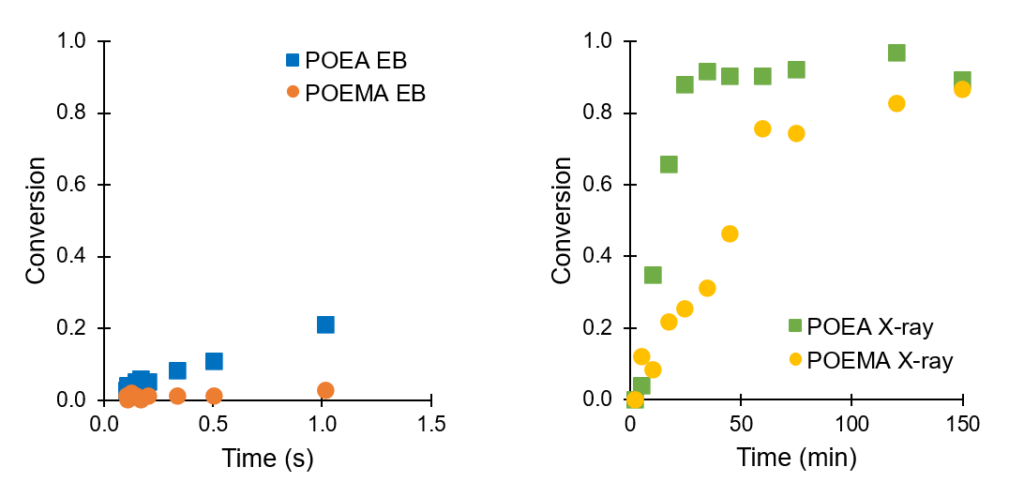
In previous studies, POEA, chosen as a part of a 5-monomer series, and its analogous methacrylate POEMA, were polymerized by EB and found to be poor converters as neat monomers (see Figure 2). 7 At 200 kGy, POEA has a fractional conversion of 0.2, and POEMA only achieves a fractional conversion of 0.03, which was within the error (~5%) of the Raman instrument. The fractional conversion of the methacrylate was increased to 0.08 when the dose rate was halved to 100 kGy/s, leading to the hypothesis that methacrylates, generally, do not fare well in EB polymerization because of the high dose rates. Testing this hypothesis is difficult as most commercial EB systems are designed to push the upper limits of dose rate, not the lower limits.
The naturally lower dose rates of commercial x-ray systems provide an opportunity to research this hypothesis, as well as to explore the implications of the results on potential applications, as discussed in the Introduction. The dose rate of the x-ray-initiated POEA and POEMA polymerization reactions in Figure 2 (right) was ~400 Gy/min – a difference of five orders of magnitude from that of the EB samples. At this reduced dose rate, both POEA and POEMA are substantially better converters, with both reaching a fractional conversion of ~0.9. As expected with its more stable propagating radical, POEMA reacts more slowly than POEA. POEA reaches 90% conversion at 25 minutes exposure time, then plateaus. POEMA appears to exhibit autoacceleration in the first 60 minutes (similar to what has been previously observed with hydroxyethylmethacrylate [HEMA] in photopolymerizations), 9 and then its propagation slows, probably due to reactive diffusion in a highly crosslinked system.
The higher conversions exhibited by both POEA and POEMA when initiated by x-ray, although only two monomers, bode well for x-ray polymerization applications. Acrylates and methacrylates that are left out of EB-polymerizable formulations for poor performance may not need to be excluded from x-ray-initiated formulations, widening the pool of monomers and oligomers. The possibility of incorporating more methacrylates, especially, is intriguing because their properties can differ from their acrylate counterparts, including increased rigidity, heat resistance and weatherability. 10,11 Moreover, the dose at which POEA and POEMA have reached these conversion levels is significantly less than would be expected based on their EB polymerization data. It only takes ~10 kGy for POEA to achieve 90% conversion in 25 minutes, which is a much higher conversion with x-ray than EB at 1/20th the dose. POEMA requires ~70 kGy to achieve the same level of conversion in 150 minutes. Although these exposure times are still substantially greater than EB, the throughput of an x-ray polymerization could be a fraction of what is predicted. For example, 30 kGy is a fairly typical dose for EB polymerization of inks and coatings; yet, if an acrylate formulation can be fully cured with only 10 kGy using x-ray, that will increase the throughput threefold from what may initially be estimated.
Sol-gel Analysis
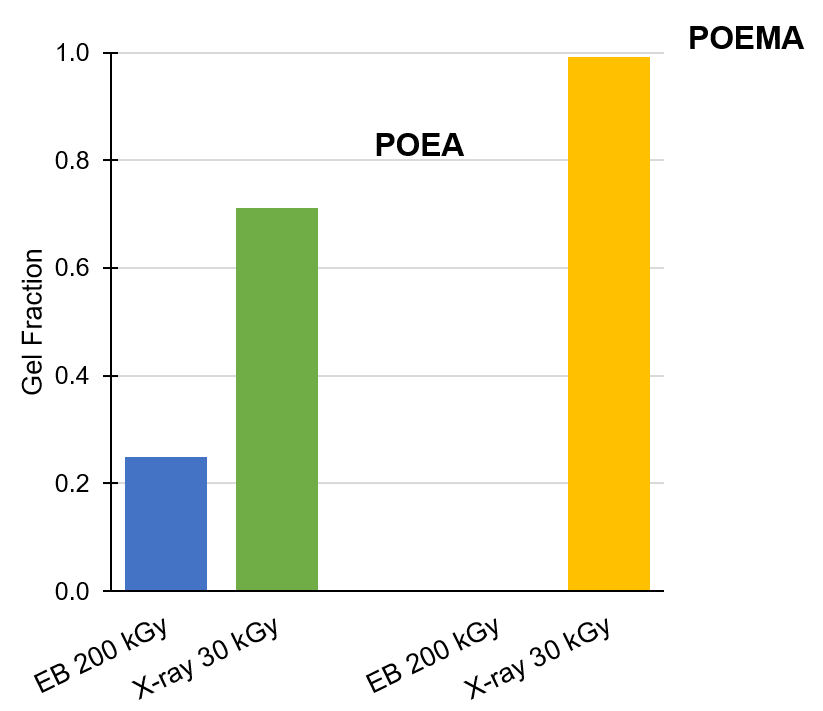
Perhaps unsurprisingly, based on the polymer conversion results, there is a significant difference between the crosslinked (gel) fraction of EB-initiated samples compared to x-ray-initiated samples (see Figure 3). The x-ray-initiated data was collected at ~30 kGy (75 minutes exposure); however, since neither EB-initiated monomer exhibited any conversion at 30 kGy, the EB results in Figure 3 are for samples exposed to 200 kGy (1 second exposure). With negligible conversion even at 200 kGy, EB-cured POEMA produced no gel fraction. In contrast, x-ray-cured POEMA is completely crosslinked. The gel fraction of POEA increased from 0.25 to 0.7 when initiated by x-ray in comparison to EB.
Although there generally is a correlation between conversion levels and gel fraction, it is not absolute. Here, despite having a lower fractional conversion at 75 minutes than x-ray-cured POEA (0.75 compared to 0.9, Figure 2, right), POEMA exhibits a larger gel fraction (see Figure 3). This result is unexpected, especially since crosslinking of monofunctional monomers is generally restricted to chain transfer. However, with ionizing radiation, such as EB and x-ray, the formation of radicals on monomers (not including the (meth)acrylate vinyl bond) and polymer chains (growing or terminated) is possible and can lead to crosslinking. It still is impressive if this radical formation is the mechanism by which 25% of the methacrylate monomer was incorporated into the polymer network. Further study is needed to confirm these results and investigate the network structure more specifically. If low migration of monofunctional monomers is possible by x-ray polymerization, it provides additional flexibility in formulating.
Conclusions
In summary, a comparison was made of EB and x-ray polymerization of a monofunctional acrylate and its analogous methacrylate. Polymer conversion was measured as a function of exposure time using Raman spectroscopy and revealed significant differences between EB and x-ray initiation. The slower dose rate of x-ray was shown to have a positive effect on both the acrylate and methacrylate conversions, achieving conversion levels not seen with EB and using a fraction of the dose. Sol-gel measurements demonstrated that the x-ray-initiated monomers had a high gel content despite being monofunctional.
More broadly, the results of this preliminary study imply that what is expected with EB-initiated polymerization, in terms of well-performing monomers, kinetics and final polymer properties, is not necessarily transferable to x-ray-initiated polymerization. While this conclusion likely means more research when considering x-ray for an application, it also potentially means more choices for formulating (specifically methacrylates and monofunctional monomers) and increased throughputs compared to those calculated using EB dose requirements (although still significantly lower than low-energy EB).
These initial studies have demonstrated a difference between EB and x-ray polymerizations, but future work is required to better understand the extent and implications of this difference. The comparison of the two technologies needs to be expanded to a wider variety of monomers and oligomers to confirm the trends seen in this study and to unearth new trends. The radiation chemical yield of primary radicals (G(R•)) should be measured 12 and compared to ensure the differences between EB and x-ray are due to dose rate and not the number of primary radicals created. Additionally, network differences could be better assessed by comparing the sol-gel and DMA results of EB- and x-ray-cured polymers with similar conversion levels.
X-ray polymerization is an undeveloped area of radiation technology. A better understanding of its benefits and limitations will enhance the adoption of this sustainable technology and grow our arsenal of green methods!
Acknowledgements
This work was supported by the National Science Foundation [grant number 1264622].
Editor’s Note: This issue’s column is reprinted from a co-authored paper, written by EB Columnist Sage Schissel and Finnis Ginder and Julie L. P. Jessop, Mississippi State University, School of Chemical Engineering.
References
7. Thiher, N.L.K., Schissel, S.M., Jessop, J.L.P., “The Influence of Monomer Chemistry on Radical Formation and Secondary Reactions During Electron-beam Polymerization,” Journal of Polymer Science, 58(7), 2020, pp. 1011-1021. https://doi.org/10.1002/pol.20190113
8. Schissel, S.M., Lapin, S.C., Jessop, J.L.P., “Internal reference validation for EB-cured polymer conversions measured via Raman spectroscopy,” RadTech Report, 28(4), 2014, pp. 46-50. https://www.radtech.org/magazinearchives/Publications/RadTechReport/dec-2014/InternalReferenceValidationforEB-CuredPolymerConversionsMeasuredviaRamanSpectroscopy.pdf
9. Schissel, S.M., Jessop, J.L.P., “Enhancing Epoxide Kinetics and Tuning Polymer Properties Using Hydroxyl-containing (Meth)acrylates in Hybrid Photopolymerizations,” Polymer, 161, 2019, pp. 78-91. https://doi.org/10.1016/j.polymer.2018.12.010
10. Odian, G., Principles of Polymerization, 4th ed., John-Wiley and Sons, Inc.: New Jersey, 2004.
11. deLombard-Watts, M., Weissman, P.T., “Comparison of performance of acrylate and methacrylate aliphatic urethanes,” RadTech International Conference, 2004. https://www.radtech.org/proceedings/2004/papers/087.pdf
12. Thiher, N.L.K., Schissel, S.M., Jessop, J.L.P., “Counting Radicals: Methods to Measure Radiation Yields of Monomers in EB Polymerization,” UV+EB Technology, 5(2), 2019, 32-40. https://uvebtech.com/articles/2019/counting-radicals-methods-to-measure-radiation-yields-of-monomers-in-eb-polymerization/

Sage Schissel, Ph.D.
Applications Specialist
PCT Ebeam and Integration LLC
sage.schissel@pctebi.com