


In the 1st Quarter 2023 edition of “Professor’s Corner,” we discussed the reaction kinetics of free radical UV polymerization. 1 In the 2nd Quarter 2026 edition of “Professor’s Corner,” we discussed the kinetics of cationic UV polymerization. 2 Both processes involve “chain-growth” polymerization, but they significantly differ in the raw materials used and the reaction conditions employed. So, with this background in the kinetics of these two different photopolymerization processes, it seems a good time to wrap up these kinetic studies by introducing a third process for photopolymerization: thiol-ene UV polymerization.
Thiol-ene photopolymerization differs from the other two processes in that it is not a chain-growth polymerization process at all! On the contrary, it is a step-growth process, albeit a free radically initiated one. The mechanism for step-growth involves reactions between typical organic functional groups. For example, a carboxylic acid group (-COOH) will react readily with an alcohol (-OH) to produce an ester linkage. 3 This particular reaction will produce a by-product of H2O. This fact gave the earlier name to this process of “condensation polymerization.” But when a similar reaction occurs between an isocyanate (-N=C=O) and an alcohol (-OH), a urethane linkage is formed, but there is no low molecular mass byproduct produced. Both types of reactions are step-growth reactions, but the urethane production process is not a condensation reaction, because no low molecular mass byproduct is “condensed” out of the reaction.
Step-growth polymerization, then, proceeds step-by-step-by-step from reactants to products. 4 But, for the process to work to form polymers, it must start with monomers (or repeat units) that contain a minimum of two functional groups per molecule. In other words, there must be a one-to-one ratio of reactive groups on each monomer unit. If this ratio is present, then a linear polymer should form. If the ratio is not one-to-one – in other words, if some of the monomers are only monofunctional – then some of the functional groups will have nothing to react with, and this will result in unreacted functional groups and will, in effect, cause the reaction to stop before a significantly large molecular mass can be obtained.
To illustrate this, let’s assume we have a mixture of two different difunctional monomers, such as a diisocyanate and a di-alcohol, [O=C=N-R1-N=C=O + HO-R2-OH]. Both of these monomers are in a liquid state and, as the mixture is heated and stirred, eventually conditions will prevail everywhere throughout the mixture wherein the functional groups will react together, first by forming urethane dimers throughout the reaction mixture:
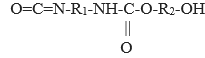
Note: R1 and R2 may be the same or different!
This reaction leaves both functional groups intact on the dimer molecule, meaning that the polymerization now can proceed to make a larger and larger linear molecule. In effect, this is a “living polymerization” process! All one must do to continue the reaction is to add more of both monomers. But it is important to realize that continued growth of the polymer chain will require that the stoichiometry of the two functional groups must be exactly 1:1 if a truly linear molecule of significant molecular mass is to be obtained. If the ratio is not 1:1, then unreacted functional groups will have nothing further to react with and therefore will act as “chain stoppers,” ending the reaction. For further details on the nature of the step-growth polymerization process, please see References 3 and 4.
The Kinetics of Thiol-ene Photopolymerization
Now let’s look at the specific application we’re discussing in this edition of “Prof’s Corner,” the reaction of acrylates, methacrylates, vinyls or other “-enes” with polythiols [R-(-SH)x]. This is the point where we see this type of process as a bridge between chain-growth polymerization involving free radicals and the free radical-initiated step-growth polymerization. It is time to recognize that, for UV photopolymerization, the types of raw materials used in this process – the thiols – will produce very rapid reactions with any double-bond-containing species, i.e., “any -ene,” 5 through a very rapid chain-transfer process. However, it must be noted that in this case, the “-ene” must be at least difunctional and the thiol must be at least trifunctional if the crosslinking reaction is to proceed at a sufficient rate as to be of practical commercial importance.
Thiols, a.k.a. “mercaptans,” are analogous to alcohols in that the oxygen atom of the -OH group has been replaced by its Group 16 congener, sulfur. 6 This element, of course, has a lower electronegativity than does oxygen, meaning that it has much less attraction for the pair of electrons that make up the hydrogen-sulfur bond. Therefore, the H-S bond is significantly less polar than the H-O bond in an alcohol. This results in significantly less hydrogen bonding between thiol molecules in the liquid state. This, in turn, produces more volatile and lower boiling point compounds than those of the corresponding alcohols. This is part of the reason that one of the thiols’ perceived disadvantages is that they have a very unpleasant odor.
So what are the mechanistic steps for thiol-ene photopolymerizations? Classical step-growth polymerization processes do not involve an initiator. However, thiol-ene reactions do involve an initiation step in order to produce a free radical. While these do not require a traditional type I or II photoinitiator, their reactivity will be increased significantly by using one of these. 7 Reactions [1] and [2] below show the formation of a free radical from a trifunctional thiol and a photoinitiator (In-In). The chain transfer constant (CT) for a thiol is very large. This means that a very rapid transfer of a hydrogen atom to the initiator radical occurs, producing the thiyl radical(-R-S•). This thiyl radical then can attack a double bond or, theoretically,

it can extract another hydrogen atom from another thiol. But due to the very large CT of the thiol, invariably the thiyl radical attacks a double bond on a monomer molecule. After all, the thiyl formed because of the thiol’s basic desire to shed the hydrogen atom. So, why would it want to simply take another hydrogen atom back? This is the secret to the rapid polymerization of the system. The thiyl radical, then, initiates the polymerization with the double-bond-containing monomer (Reaction [3]). In this reaction, the thiyl radical attacks the terminal carbon atom of one of the double bonds of the monomer, initiating the polymerization in the process. One electron from the p-bond forms an s-bond between the sulfur atom and the terminal carbon atom involved in the double bond, while the second electron becomes a free radical that is now capable of extracting a hydrogen atom from another thiol molecule. Thus, the propagation of the polymerization process continues step-by-step-by-step.

As long as initiator radicals are being formed and double bonds are present, the propagation reactions will continue in thiol-ene photopolymerization.
Professor Charles Hoyle made many advances in the field of thiol-ene photochemistry. One very important contribution was his 2004 review article titled, “Thiol-enes: Chemistry of the Past with Promise of the Future.” 8This is an excellent source of more detailed information about this particular process.
References
- Christmas, Byron, “Professor’s Corner,” UV+EB Technology,Vol. 9, No. 1, pp. 16-17.
- Christmas, Byron, “Professor’s Corner,” UV +EB Technology, Vol. 12, No. 2, pp. 14-15.
- Christmas, B. & Idacavage, M., Photopolymerization: Fundamental Polymer Chemistry & Industrial Applications, DEStech Publications, Inc., 2023, pp. 41-43.
- ibid., pp. 44-48.
- Personal Conversations With Prof. Charles Hoyle: In many conversations with Prof. Hoyle about thiol-ene photopolymerizations, he would periodically state in very enthusiastic tones that, “…thiols would react with ‘Any -Ene, ANY -ENE!’” Of course, by this he meant any species containing double bonds.
- Christmas, B. & Idacavage, M., op. cit., pg. 65.
- ibid., pp. 86-87.
- Hoyle, C. E., Lee, T. Y., & Roper, T., (2004), “Thiol-enes: Chemistry of the Past with Promise of the Future,” J. Polym. Sci., Part A-Polym. Chem. 42, pp. 5301-5338.
Byron K. Christmas, Ph.D.
Professor of Chemistry, Emeritus
University of Houston-Downtown
b4christmas@gmail.com