


By Carlo Trentalange, application chemist, Radlab AG
Direct adhesion of acrylate-based UV coatings to metal surfaces traditionally has posed challenges due to the intrinsic kinetics of radical photopolymerization chemistry. Nonetheless, interest in UV technology for metal applications has grown significantly in recent years, primarily driven by the benefits of lower energy consumption and faster curing times. This study aims to examine the most effective acrylate oligomers and formulations for UV metal coatings and explore various methods to improve adhesion to different metal substrates, with special emphasis on coating flexibility and reactivity.
Introduction
UV-curable acrylate coatings are used widely in industrial metal finishing due to their fast curing, low energy consumption, reduced processing times and ability to be formulated without harmful solvents. These advantages have driven their adoption in applications such as coil coating, can coating and packaging, where sustainability and high throughput are essential. The rapid UV-induced polymerization enables near-instantaneous curing, significantly reducing production bottlenecks compared to conventional thermal curing processes. However, achieving strong and durable adhesion to metallic substrates remains a key limitation. The main cause of adhesion failure is polymerization-induced shrinkage, which generates internal stresses at the coating-substrate interface and can lead to delamination or loss of adhesion under mechanical or environmental stress. 1, 2
This study investigates the adhesion performance of urethane, polyester and epoxy acrylate oligomers formulated with reactive diluents such as isobornyl acrylate (IBOA), cyclic trimethylolpropane formal acrylate (CTFA) and other monomers. The aim is to correlate adhesion behavior with formulation parameters such as oligomer functionality, reactivity and cure-induced shrinkage. Two complementary strategies are evaluated to improve adhesion: 1) use of acidic adhesion promoters, which enhance chemical interactions between coating and metal substrate through covalent or coordinate bonding, and 2) use of adhesion resins or plasticizers, which increase network flexibility and reduce shrinkage-induced internal stresses. Together, these methods aim to enhance both the flexibility and adhesion performance of UV-curable coatings applied to metallic substrates. 3, 4, 5
Experimental Set-Up
Materials
A series of acrylate-based oligomers, including urethane acrylates (UA-n(f)), epoxy acrylates (EA-n(f)) and polyester acrylates (PEA-n(f)), were selected for the formulation of UV-curable coatings. In this nomenclature, n represents the identifier for the specific oligomer (ranging from 1 to 26 for urethane acrylates, 1 to 7 for epoxy acrylates and 1 to 5 for polyester acrylates), while f denotes the acrylate functionality, which can range from monofunctional (f = 1) to hexafunctional (f = 6). These oligomers differ in their backbone chemistry, molecular weight and functionality, going from flexible to more rigid structures. This selection was made to evaluate how varying backbone structures and functionalities influence adhesion and reactivity when applied to metal substrates.
Various reactive diluents were tested to define their effect on adhesion in combination with a few selected oligomers. The choice of diluent was critical in adjusting the viscosity, reactivity and cure kinetics of the formulations. Different reactive diluents were evaluated, namely: Cyclic Trimethylolpropane Formal Acrylate (CTFA), Isobornyl Acrylate (IBOA), Acryloylmorpholine (ACMO), Dimethylacrylamide (DMAA), Dicyclopentanyl Acrylate (DCPA), Lauryl Acrylate (LA), Isodecyl Acrylate (IDA), Poly(ethylene oxide) Phenyl Ether Acrylate (PH(EO)A) and a monofunctional urethane acrylate (UA-1).
To improve adhesion to metal substrates, the effect of adhesion of acid ester phosphate (AP) and an adhesion resin (AR-1) was tested.
Metal substrates used in this study for adhesion and bending tests were obtained from Q-Panel and included cold rolled steel (CRS) dull matte finish, Aluminum (Alu) smooth mill finish and electroplated steel tinplate (ETP) smooth mill. All substrates were degreased with acetone prior to use.
Applications and Methods
Formulations consisting of oligomers, monomers and photoinitiators were prepared by combining the components in 20 g black vials. The mixtures were thoroughly blended using a Hauschild DAC150.1 FVZ SpeedMixer until complete dissolution of the components was achieved. The resulting formulations were applied to standard Q-panels using a 12 µm handcoater. Curing was performed with a UV Fusion Belt Lamp equipped with a UV mercury bulb with maximum output 240 W/cm, operating at a belt speed of 10 m/min, corresponding to a total applied UV dose of 1800 mJ/cm² (total UV dose).
Adhesion ASTM D3359
Adhesion of the UV-curable coatings to metal substrates was evaluated using the cross-cut test in accordance with ASTM D3359, method B. Coated aluminum, CRS and ETP Q-panels were scored using a standardized crosshatch cutter to create a lattice pattern through the film to the substrate. After scoring, panels were conditioned at room temperature for one hour prior to testing. A pressure-sensitive adhesive tape (Tesa® 4140, compliant with the standard) was applied firmly over the grid area and then removed at a consistent angle and speed. The amount of coating removed was assessed visually and rated according to the ASTM 0B to 5B classification scale, where 5B indicates no film removal and excellent adhesion.
Solvent Resistance ASTM D5402
Solvent resistance of the UV-cured coatings was evaluated according to ASTM D5402 using methyl ethyl ketone (MEK). A cotton swab saturated with MEK manually was rubbed back and forth over the coating, with one forward and backward motion counted as one double rub. Testing continued for up to 100 double rubs or until visible coating failure occurred, including softening, discoloration or film removal.
Flexibility Using T Bend ASTM D4145
Flexibility of the UV-cured coatings was evaluated on coated ETP panels using the T-bend test according to ASTM D4145. Panels manually were folded to form a tight “T” shape, after which adhesive tape was applied along the bend and rapidly removed to assess adhesion. Coatings were inspected for cracking and delamination (pick off), and additional bends were performed if failure was observed in one or both parameters. Results were reported as the lowest bend level (e.g., 0T, 0.5T, 1T) at which the coating remained intact, with 0T indicating no visible failure after a 180° bend.
Results and Discussion
Monomer Adhesion
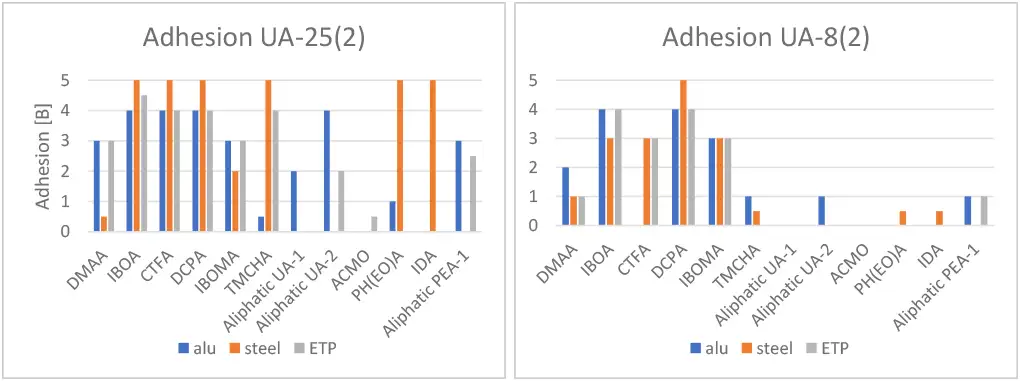
Among the urethane acrylates (UA) evaluated, UA-8(2) and UA-25(2) were selected for further testing in combination with various reactive diluents. These two oligomers were chosen based on their initial adhesion performance in pre-screening tests, where they demonstrated partial adhesion to at least one of the metal substrates. Their reactivity profiles allowed for a clear evaluation of how different monomers influence adhesion behavior. Each formulation was prepared by mixing 50% oligomer, 45% reactive diluent and 5% of a liquid photoinitiator blend. The adhesion value of each dilution on the three different substrates is shown in Figure 1.
From the plotted data, it is evident that UA-25(2) generally performs better than UA-8(2) when combined with various monomers, likely due to the longer backbone structure and higher molecular weight. A trend also can be observed across all three substrates – ETP, CRS and aluminum – where certain monomers consistently result in higher adhesion. In particular, IBOA, CTFA and DCPA exhibited superior overall adhesion across the board. Although not universally true, steel appeared to be the most favorable substrate for adhesion, often showing better performance compared to aluminum and ETP. In some cases, monomers such as IDA and PH(EO)A showed high adhesion on steel but failed to adhere to the other substrates. Conversely, certain monomers, including ACMO, demonstrated no adhesion across all tested substrates.
Oligomer Adhesion
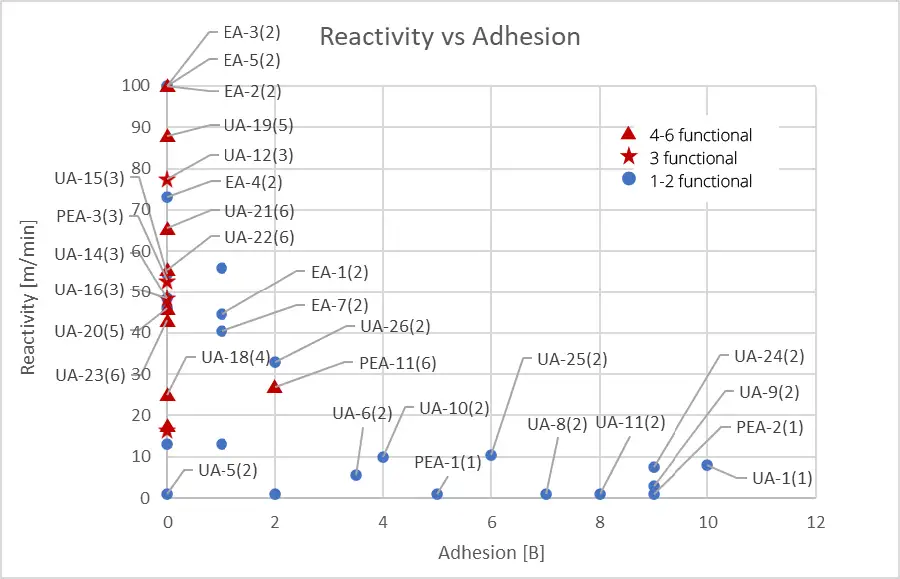
Based on the reactive diluent screening of the previous study, IBOA was chosen to be used in combination with a selection of UA, EA and PEA with different molecular weight and functionality. The formulations were prepared using 50% oligomer, 45% monomer and 5% of a liquid photoinitiator blend. Adhesion was tested using the same method, and total adhesion obtained as sum of adhesion on CRS and aluminum as a function of oligomer reactivity was plotted in Figure 2.
The plot reveals a general inverse relationship between oligomer reactivity and adhesion to the metal substrate. This trend also is reflected in the number of acrylate functionalities: oligomers containing one or two functional groups generally exhibited better adhesion, whereas those with three or more functionalities typically showed poor or no adhesion. Since higher functionality is associated with increased reactivity and crosslinking density, it also leads to greater polymerization shrinkage during curing. The resulting internal stresses can weaken interfacial bonding and promote detachment of the coating from the substrate. This behavior is exemplified by highly functional oligomers such as UA-19(5) and PEA-11(6), which showed poor adhesion despite their high reactivity. Although higher reactivity and functionality generally correlate with reduced adhesion, the opposite is not always true, as some low-reactivity, low-functionality oligomers, such as UA-2(2) and UA-5(2), also exhibited poor adhesion. Nevertheless, a clear trend emerges from the data: no oligomer with a reactivity above 20 m/min or more than two acrylate functionalities demonstrated acceptable adhesion performance.
Effect of Acidic Adhesion Promoter on Adhesion and Flexibility
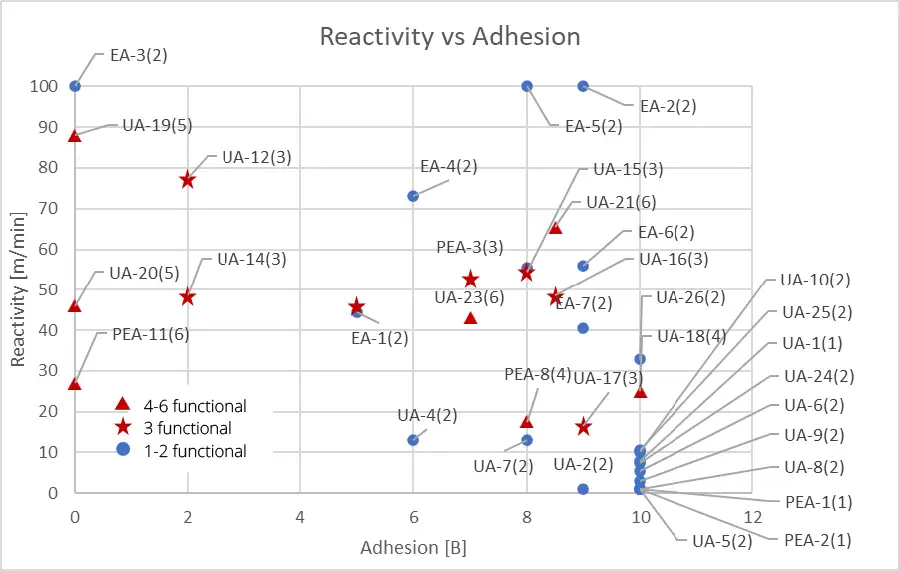
To improve adhesion performance, 2 wt% of an acidic adhesion promoter (AP) was added to the oligomer/monomer formulations evaluated in the previous study. The resulting adhesion data are presented in Figure 3.
The addition of AP improved adhesion in almost all cases, demonstrating that even highly functional oligomers, which typically are associated with greater polymerization shrinkage, can achieve good or partial adhesion on both aluminum and steel. This effect is illustrated by oligomers such as UA-23(6), PEA-8(4) and UA-18(4), which exhibited acceptable adhesion when combined with AP. Similarly, highly reactive epoxy acrylates EA-5(2) and EA-2(2) showed good adhesion on both substrates.
Although the oligomers exhibiting perfect adhesion on both aluminum and steel were predominantly difunctional (except for UA-18(4)), the addition of AP resulted in a more homogeneous distribution of adhesion performance across the oligomer portfolio, providing greater flexibility for direct-to-metal formulations. Nevertheless, some highly functional oligomers, particularly UA-19(5) and UA-20(5), continued to show poor adhesion despite the presence of AP.
While the use of acidic adhesion promoters expands formulation options, it also may introduce storage stability concerns due to potential reactions with certain oligomers. In some cases, oligomer degradation has been observed at AP concentrations as low as 0.5 wt%, indicating that formulation stability must be assessed individually for each system.
Effect of Adhesion Resin on Metal Adhesion and Flexibility
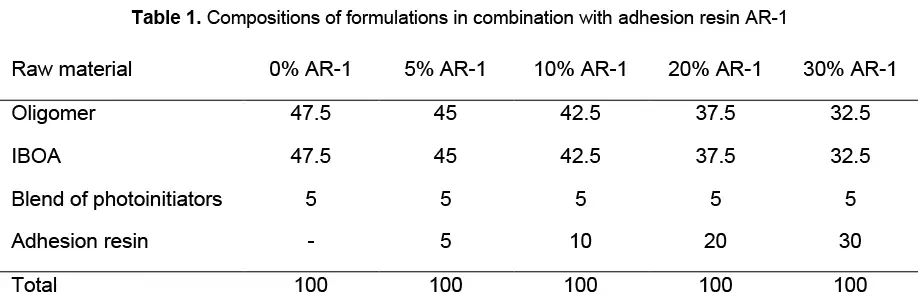
As an alternative approach to improving adhesion in UV-curable coatings, the effect of an adhesion resin acting as a plasticizer was investigated. The base formulation consisted of a 1:1 weight ratio of isobornyl acrylate (IBOA) and selected oligomers (UA-8(2), UA-10(2), UA-25(2) and PEA-3(3)), together with 5 wt% of a liquid photoinitiator blend. Adhesion resin was added at concentrations of 5, 10, 20 and 30 wt% while maintaining a constant IBOA-to-oligomer ratio. To evaluate flexibility by T-bend testing, 1 wt% of an acidic adhesion promoter was included to ensure sufficient adhesion to the metal substrate and prevent premature delamination.
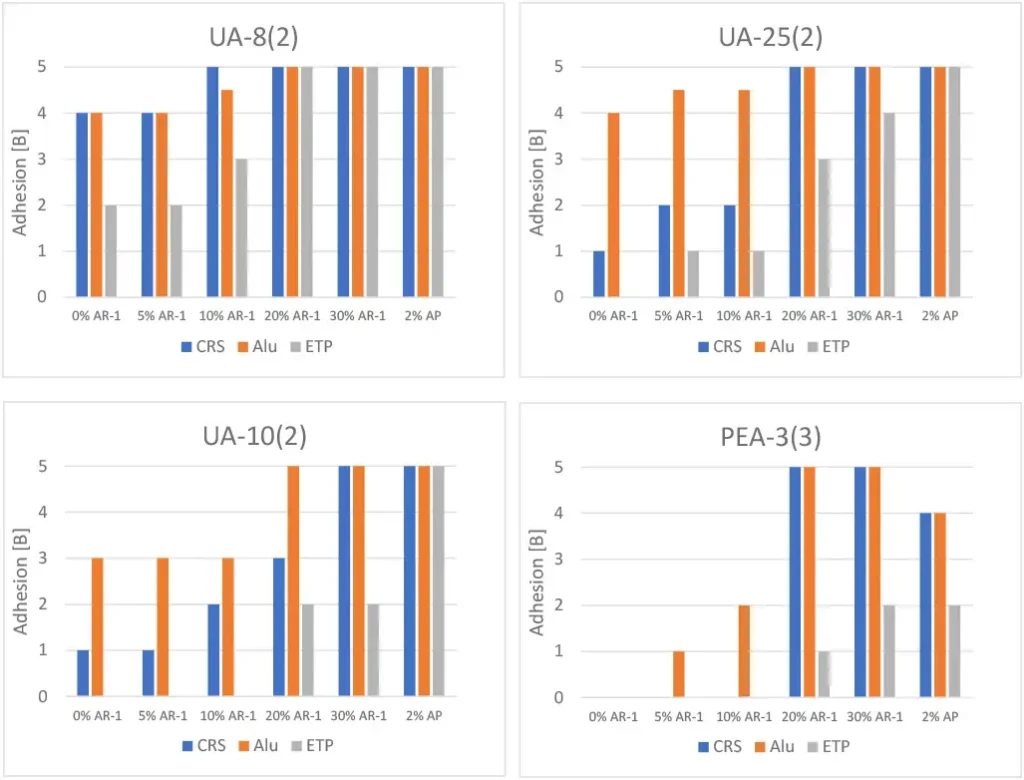
As shown in Figure 4a-d, the addition of adhesion resin improved adhesion on all three metal substrates for every oligomer tested. Aluminum exhibited the highest adhesion levels, followed by CRS, while ETP proved to be the most difficult substrate. Two distinct behaviors were observed among the oligomers. Some, such as UA-8(2), already displayed partial adhesion without additives, whereas others, such as PEA-3(3), showed no adhesion in the absence of either an adhesion promoter or adhesion resin. For UA-8(2), the formulation containing only IBOA achieved adhesion ratings of 4B on aluminum and CRS and 2B on ETP. While low adhesion resin concentrations had little effect, increasing the adhesion resin content to 10 wt% significantly improved adhesion, raising the ratings to 4.5B on aluminum, 5B on CRS and 3B on ETP.
At an adhesion resin concentration of 20 wt%, excellent adhesion was achieved for all tested oligomers, with performance comparable to or exceeding that obtained using 2 wt% acidic adhesion promoter (AP). For example, UA-8(2) reached a 5B rating on all substrates at 20 wt% adhesion resin, while PEA-3(3), which initially exhibited no
adhesion, improved to 5B on aluminum and CRS. ETP remained the most challenging substrate, with PEA-3(3) reaching only 1B and 2B adhesion at 20 and 30 wt% adhesion resin, respectively. Overall, the data indicates that 20 wt% adhesion resin represents an optimal concentration for significantly enhancing adhesion.
The addition of adhesion resin also improved coating flexibility. Little change was observed at 5 wt%, whereas a clear reduction in T-bend values was measured at 20 wt%, indicating increased flexibility. For example, UA-10(2) and UA-25(2) improved from 1T to 0.5T, while PEA-3(3) improved from 2T to 1T. UA-8(2), the most flexible oligomer tested, showed improvements already at 10 wt% adhesion resin. Further increases to 30 wt% provided additional gains in flexibility.
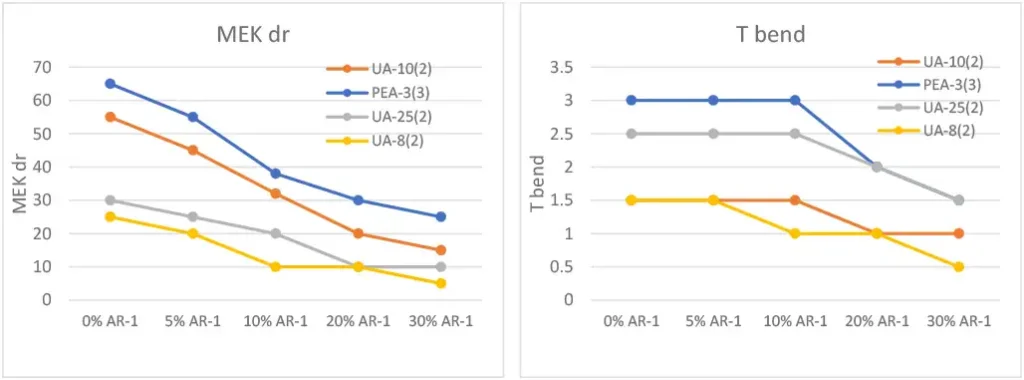
However, higher adhesion resin concentrations reduced solvent resistance. Since the adhesion resin acts primarily as a plasticizer, its incorporation lowers the crosslink density of the cured network. Consequently, MEK double-rub resistance decreased approximately linearly with increasing adhesion resin content for all oligomers tested, indicating progressive film softening and reduced network density.
Conclusions
This study examined the relationship between acrylate oligomer structure and adhesion to metal substrates. High oligomer functionality and reactivity, while beneficial for rapid curing, generally reduced adhesion due to increased polymerization shrinkage and interfacial stress. Oligomers with three or more acrylate functionalities consistently exhibited poor adhesion on aluminum, cold rolled steel (CRS) and electroplated tinplate (ETP), while lower-functionality oligomers generally performed better. A similar trend was observed for reactivity, as oligomers with curing speeds above 20 m/min showed poor adhesion. However, low reactivity alone did not guarantee good adhesion, indicating that other structural factors also contribute to interfacial performance.
Reactive diluents were found to strongly influence adhesion. Monomers such as IBOA, CTFA and DCPA consistently enhanced adhesion across all substrates, whereas others with similar reactivity did not, highlighting the importance of monomer chemistry beyond curing speed.
The addition of an acidic adhesion promoter (AP) significantly improved adhesion for most oligomers, including highly functional materials, suggesting that chemical interaction with the substrate can partially offset shrinkage-induced stresses. However, the use of AP may introduce formulation stability issues, particularly at higher concentrations.
As an alternative strategy, the adhesion resin AR-1 effectively improved both adhesion and flexibility. At an optimal concentration of 20 wt%, it provided adhesion performance comparable to or better than that achieved with conventional acidic adhesion promoters, especially when combined with 1 wt% AP. This benefit was accompanied by reduced solvent resistance due to lower crosslink density, requiring a balance between adhesion, flexibility and chemical resistance when designing formulations.
References
- Moeck et al. Shrinkage of UV Oligomers and Monomers, Radtech Europe, 2014
- He et al., Shrinkage in UV-Curable Coatings, Protective Coatings. Springer, Cham., 2017
- Bratslavsky et al., High-Performance UV-curable Coatings for Different Metal Substrates, Radtech USA, 2008
- Schaeffer et al., Acrylated Products Designed for Formability and Adhesion Enhancement in Direct-to-Metal Applications,Radtech USA, 2010
- Chiang et al., A study of monomer’s effect on adhesion strength of UV-curable resins, International Journal of Adhesion and Adhesives,Volume 26, Issue 7, 2006, Pages 520-531.

Carlo Trentalange earned a bachelor’s degree in chemical engineering from Politecnico di Torino, Italy, and a master’s degree from the Karlsruhe Institute of Technology (KIT), Germany. His studies and research focused on polymer chemistry, with a particular emphasis on photopolymers and UV-curable materials. Following his academic career, he gained industrial experience in both Italy and Switzerland, working on the development and application of UV-curable coatings. Trentalange currently is an application chemist at RadLab AG, where he specializes in supporting product development and application optimization for coil coating, packaging and industrial coating markets. For more information, email carlo.trentalange@rahn-group.com or visit www.rahn-group.com.