


By Paolo Betti, synthesis manager, IGM Resins
Self-curing resins represent a significant advancement in the field of polymeric materials in UV technology. Due to the increasing regulatory concerns linked to certain classes of low-molecular-weight photoinitiators, the development of formulations based on resins with built-in initiation capability has become an attractive alternative. Unlike conventional formulations that require photoinitiators to start the radical polymerization of acrylated resins, self-curing resins carry a functional group that can convert UV energy into radicals, eliminating the addition of the photoinitiator to the formulation. This article describes a new glyoxylate self-curing resin, suitable for LED curing in a wide range of applications.
Introduction
Advanced UV-curing technologies increasingly are required to comply with demanding performance and regulatory requirements, particularly in sectors such as food packaging, high-performance coatings and sensitive industrial applications. 1 In these contexts, the presence of migrating species represents a major limitation, as materials must comply with strict requirements ensuring that no harmful substances are released from the polymer matrix. Conventional UV-curable formulations typically are based on multi-component systems in which photoinitiators play a central role in triggering polymerization. However, these molecules generally are relatively low-molecular-weight and either can migrate from the cured film or generate low-molecular-weight byproducts upon irradiation. This issue becomes critical in applications where very low migration levels are required, pushing formulators to continuously balance reactivity, performance and compliance. To address these limitations, significant efforts have been made over the years to reduce the mobility of photoinitiators; for example, through the development of polymeric or multifunctional structures. 2 While effective in lowering migration, these approaches still rely on the presence of a distinct photoinitiator component within the formulation, maintaining a separation between the curing function and the resin matrix.
More recently, the growing demand for photoinitiator-free formulations, perceived as safer and more suitable for sensitive applications, has accelerated interest in alternative curing strategies. In particular, electron beam technologies 3 have demonstrated the feasibility of eliminating photoinitiators, although their implementation often is limited by higher operational complexity and cost. In this evolving landscape, self-curable resins have emerged as a new formulation tool, offering a fundamentally different approach. 4 These materials are designed as photoactive acrylated resins in which the initiating functionality is intrinsically incorporated into the molecular structure, enabling curing without the addition of external photoinitiators. This concept allows the formulation paradigm to shift from a multi-component system toward a more integrated architecture, where the resin itself contributes both to network formation and to the initiation process. As a result, self-curable resins can be positioned as an alternative building block for UV-curing systems, particularly suited for applications requiring low migration, low extractables and high formulation robustness. Beyond regulatory compliance, the newly developed materials must be compatible with modern curing technologies, including both mercury and LED systems, thus expanding the design space for next-generation UV-curable materials.
Materials and Methods
Materials
All chemicals used in this study were commercially available products supplied by IGM Resins. In particular, LFC4591 is commercially available under the trade name PHOTOMER® SC91. ESACURE® and Photomer® are trademarks of IGM Resins.
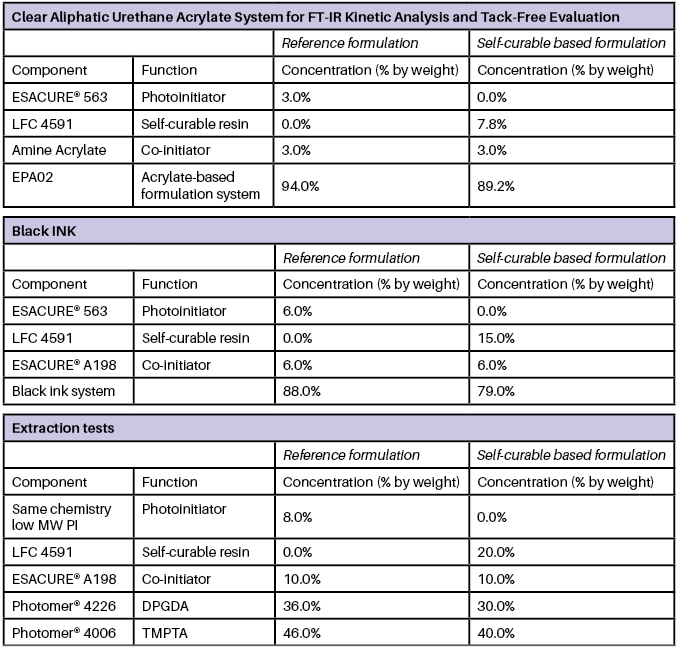
The formulations that were used in this study are summarized in Table 1.
Analytical and Curing methods
Physicochemical Characterization
- UV–Vis absorption spectra were recorded using a Shimadzu UV-2700i UV–Vis spectrophotometer. Viscosity measurements were performed at controlled temperature using a Brookfield RV-DV-I rotational viscometer.
FT‑IR Kinetics
- Photopolymerization kinetics were monitored by real-time Fourier transform infrared spectroscopy (FT-IR) using a Bruker INVENIO-S Fourier Transform Infrared Spectrometer. The decrease in the absorbance band area at 1408 cm⁻¹, assigned to the acrylate double bond, was recorded continuously as a function of irradiation time and used to calculate the monomer conversion during photopolymerization.
Clear Systems
- Curing conditions: 2 × 10 m/min (Hg 120 W/cm, UV LED 395 nm 16 W/cm2, UV LED 365 nm 16 W/cm2).
- Yellow index: The yellow index was measured using a Techkon SpectroDens instrument under D65 illumination and 10° observation angle.
- Pendulum hardness: Determined using a BYK Chemie Pendulum Hardness Tester (model 5861, Persoz method) according to ISO 1522.
- Flexibility: Evaluated using a TQC Sheen conical mandrel tester according to ISO 6860.
- Solvent resistance: Double rub test performed with Washability tester TQC AB6000. Speed 30 rubs/min. Weight 1000 g.
- Gloss: Measured using an ERICHSEN Picogloss instrument at 20° and 60° angles according to ISO 2813.

Black Ink Systems
- Black ink systems were prepared with a target optical density of 1.85 ± 0.1 and applied on YUPO BOPP substrate. Samples were cured using a UV LED source at 395 nm.
- Mechanical and solvent resistance were evaluated by double rub test using a TQC abrasion tester (model AB6010) equipped with Crockmeter accessory (Φ 16 mm). A total load of 950 g was applied, using TEM T1 abrader wipes (ISO Class 3–5, 100% PE), at a rate of 30 rubs min⁻¹ with isopropanol (IPA) as solvent. The number of rubs to failure was recorded.
Evaluation of Extractables
BOPP was used as substrate. Films were cured using two different conditions: a tack free (TF) of 18 m at 120 W cm⁻¹ and 2 × 10 m min⁻¹ at 120 W cm⁻¹. The dry film thickness is 22 µm. Two independent tests were performed for each formulation.
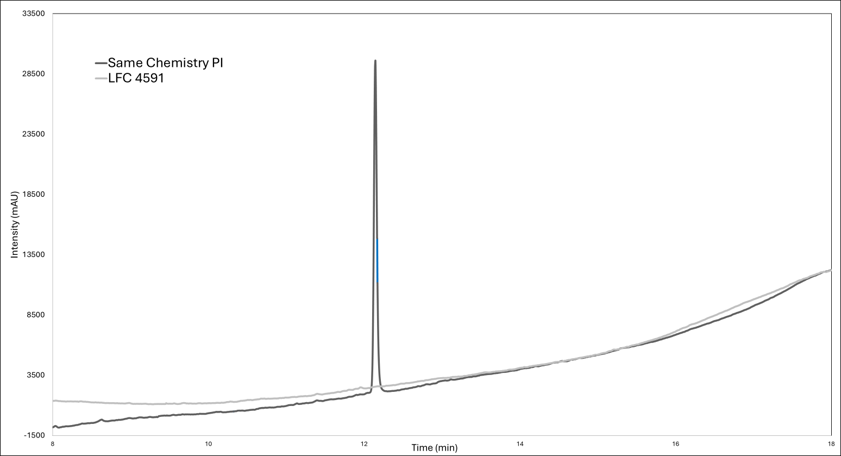
Extraction protocol: A film sample with an area of 7.9 cm² was placed in a beaker containing 4.5 mL of acetonitrile (ACN). The sample was sonicated for 10 minutes at room temperature. The extract then was quantitatively transferred to a 10 mL volumetric flask. The beaker was rinsed with ACN, and the combined solution was brought to volume and thoroughly mixed. Subsequently, the extracts were analyzed by HPLC.
Results and Discussion
The introduction of self-curable resins significantly modifies the formulation approach typically adopted in UV-curable systems. In conventional formulations, the photoinitiator represents a separate and essential component responsible for initiating polymerization, requiring careful optimization of concentration, compatibility and reactivity.
In contrast, the use of self-curable resins enables the development of photoinitiator-free systems, where the initiating function is intrinsically embedded within the resin structure.
This shift impacts not only the composition of the formulation but also the overall design strategy, as the balance between oligomers, diluents and curing species must be reconsidered.
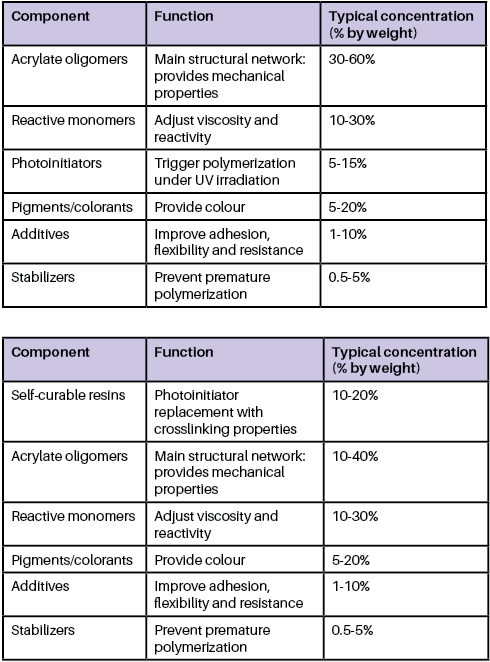
In practical terms, this approach allows the reduction or complete elimination of free photoinitiators, while maintaining the required curing performance. Typical use levels of self-curable resins are higher than those of conventional photoinitiators, reflecting their dual role in the system and their contribution to both network formation and initiation.
Characterization of LFC 4591
LFC 4591 is a self-curable acrylated resin designed to combine multiple polymerizable functions with a built-in photoactive moiety. The product is characterized by a molecular weight above 1000 g/mol and a multifunctional structure, enabling efficient incorporation into the crosslinked network upon curing.
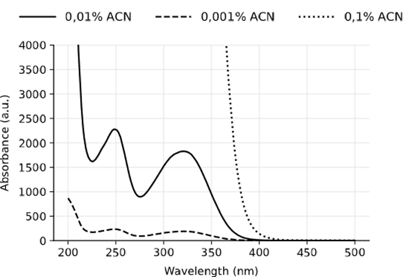
From a chemical standpoint, the reactive system is based on a Type II photoinitiation mechanism requiring the presence of a hydrogen donor (typically, an amine synergist), which plays a key role in radical generation. The chemistry of the photoactive moiety is derived from glyoxylate-based systems, consistent with technologies developed in the ESACURE 563, known for low-yellowing LED-curable applications.
As shown in Figure 2, the absorbance spectrum of LFC 4591 exhibits a broad absorption band extending from the near-UV region toward longer wavelengths, with significant intensity in the 320 to 400 nm range. This behavior is typical of glyoxylate-based Type II photoactive systems. The presence of absorption at higher wavelengths allows LFC 4591 to be activated efficiently not only under conventional mercury lamps but also under LED sources at 365 nm and 395 nm.
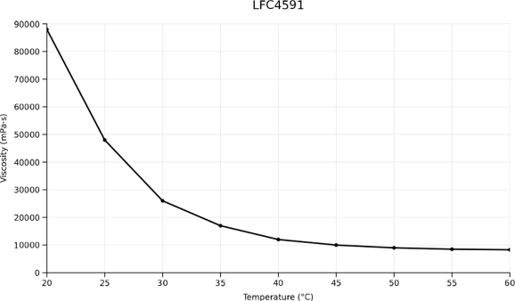
Another key property of a self-curable resin is the viscosity, as it directly impacts its handling and ease of incorporation into formulations.
As shown in Figure 3, the viscosity of LFC 4591 significantly decreases with increasing temperature. At room temperature (around 20 to 25° C), the viscosity is relatively high, in the range of ~45,000–90,000 mPa·s, but remains compatible with standard handling procedures. The material is a pourable liquid at room temperature, which represents an important practical advantage compared to other high-molecular-weight or polymer-bound systems that may require pre-heating before use.
The stability of self-curable systems represents a critical parameter for their practical implementation, as the presence of reactive functionalities and photoactive groups may raise concerns regarding storage behavior. In this context, LFC 4591 has been subjected to accelerated aging tests at 60° C for up to six weeks. Over this period, the material maintained essentially unchanged physical characteristics and curing performance, with no significant variation in viscosity, appearance or reactivity. This behavior confirms the good storage stability of the system and demonstrates that the integration of the photoactive functionality within the resin backbone does not lead to premature reactions or degradation.
Reactivity vs. Reference Photoinitiator System
The curing performance of LFC4591 was evaluated in comparison with a conventional photoinitiator system based on ESACURE 563, which relies on the same photoinitiating chemistry. The materials were assessed under both mercury lamp and UV LED irradiation conditions
The FTIR kinetic profiles clearly show that formulations based on self-curing resins, in the absence of added free photoinitiator, are capable of achieving reactivity levels comparable to those of conventional systems containing low-molecular-weight photoinitiators. In both irradiation conditions, the onset of polymerization, the rate of conversion increase and the final conversion values closely follow the trends observed for the reference formulation (Figure 4). These results demonstrate that the photoactive functionality embedded within the resin structure is sufficiently efficient to promote rapid polymerization, confirming that self-cleaving architectures effectively can replace traditional free photoinitiators without compromising kinetic performance.
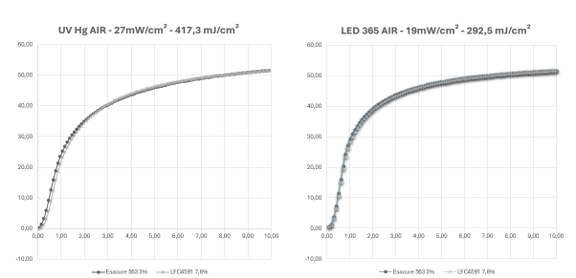
292.5 mJ cm-2) and (b) UV mercury lamp irradiation (27 mW cm-2, 417.3 mJ cm-2) in air.
Formulation Performance
The core of this work is the evaluation of LFC 4591 performance in formulated systems, with particular attention to how the self-curable concept impacts the overall formulation strategy.
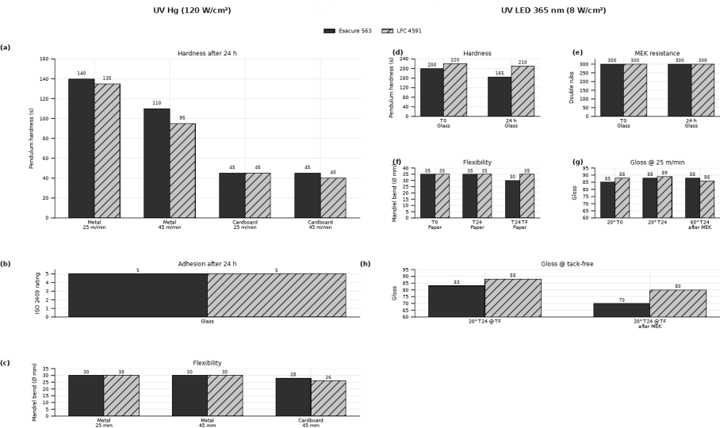
A first formulation strategy consists of treating the self-curable resin as a direct replacement for conventional photoinitiators, without altering the target performance of the original system. When the formulation is properly rebalanced to account for its incorporation, key properties – such as reactivity, viscosity, hardness and overall coating performance – remain unchanged. In practical terms, this is achieved by redistributing the different components starting from a conventional reference formulation based on ESACURE 563, in order to maintain comparable reactive group density and formulation integrity.
In clear coating systems, this balanced approach allows a direct comparison between the two technologies. Under these conditions, LFC 4591 demonstrates a strong overlap in final properties with the standard photoinitiator-based system.
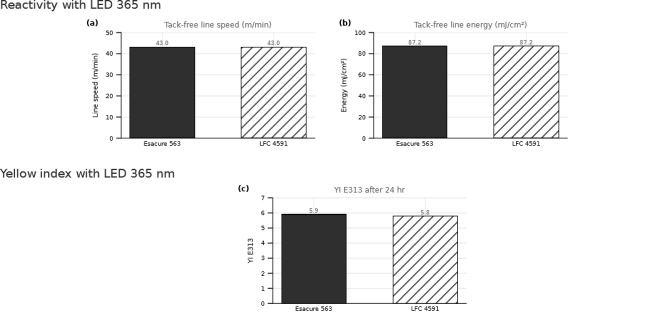
Curing efficiency, hardness, flexibility, chemical resistance and optical properties such as gloss and yellowing remain within the same performance window, confirming that the self-curable resin effectively can replace the photoinitiator without compromising the final material properties (Figure 6). This result highlights that the self-curable concept does not inherently modify the performance of the system, provided that the formulation is adapted appropriately to account for the different role and concentration of the active species.
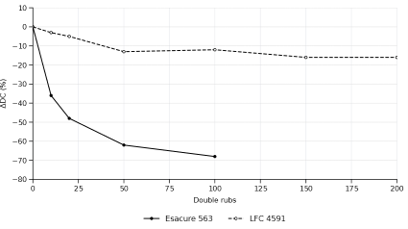
In contrast, a second approach highlights how the use of self-curable resins actively can enhance formulation performance, beyond simple photoinitiator replacement. Thanks to its intrinsic multifunctional nature, LFC 4591 contributes not only to radical generation but also to the formation of the polymer network, leading to measurable improvements in certain properties. A clear example is solvent resistance, which shows a significant increase in black ink systems, as illustrated in Figure 7.
This represents a key opportunity from a formulation standpoint: when properly leveraged during the rebalancing step, the self-curable approach enables not only the elimination of conventional photoinitiators but also an overall enhancement of the formulation performance compared to the original system.
Evaluation of Extractables
The final part of the study focuses on the evaluation of extractables, providing further support to the value of the self-curable approach in sensitive applications. By design, LFC 4591 does not contain free photoinitiators, as the photoactive functionality is covalently integrated within the resin backbone. This intrinsic characteristic significantly reduces the presence of species that typically are responsible for migration phenomena in conventional UV-curable systems.
Extraction experiments confirm this behavior. For LFC4591, no photoinitiator residues are detected above the limit of detection (<0.13 mg m⁻²). In contrast, the reference system based on a low-molecular-weight same-chemistry photoinitiator shows measurable extractable species, with an analyte content of 59 mg m⁻² under identical curing and extraction conditions (Figure 8).
Conclusion
In this work, the potential of self-curable resins has been investigated as an alternative approach to conventional photoinitiator-based UV-curing systems. The results demonstrate that LFC 4591 enables the design of photoinitiator-free formulations without compromising curing efficiency or final performance. When properly formulated, systems based on the self-curable resin show a strong overlap with conventional benchmarks in terms of curing behavior, mechanical properties, chemical resistance and optical performance. At the same time, the study highlights that the self-curable concept represents more than a simple substitution strategy. Unlike traditional low-molecular-weight photoinitiators, LFC 4591 acts as both a reactive species and a structural component, requiring a different formulation approach. This change in paradigm opens new opportunities for formulation design, allowing both equivalence with existing systems and further optimization when the system is properly balanced.
Even when introduced within standard formulation frameworks, the self-curable resin demonstrates robust curing capability and a strong responsiveness to concentration. Increasing the content of LFC 4591 leads to a progressive enhancement of both surface and through cure, while simultaneously contributing to the overall network structure. This intrinsic flexibility makes it a powerful formulation tool, particularly in complex systems such as pigmented inks, where control over curing depth and uniformity is critical.
A key advantage of the self-curable approach is confirmed by migration and extraction studies. The absence of free photoinitiator, combined with the high-molecular-weight structure of the resin, significantly reduces the presence of migratable species. This feature reinforces the suitability of LFC 4591 for low-migration and high-sensitivity applications, including food packaging, electronics and advanced industrial coatings.
Overall, the results show that self-curable resins represent a next-generation building block for UV-curing technologies, enabling the transition toward simpler, more compliant and more robust formulations. This approach not only maintains current performance standards but also provides new degrees of freedom in formulation design, positioning self-curable systems as a valuable solution for future developments in UV and LED curing.
Acknowledgements
The author would like to thank Dr. Vincenzo Razzano, Ph.D., and the IGM Resins Analytical and Application R&D teams for their valuable support in the development of this technology.
References
- Aparicio, J. L., and M. Elizalde. “Migration of Photoinitiators in Food Packaging: A Review.” Packaging Technology and Science, vol. 28, 2015, pp. 181–203.
- Zhou, Junyi, Xavier Allonas, Ahmad Ibrahim, and Xiaoxuan Liu. “Progress in the Development of Polymeric and Multifunctional Photoinitiators.” Progress in Polymer Science, vol. 99, 2019, article 101165.
- Cleland, M. R., L. A. Parks, and S. Cheng. “Applications for Radiation Processing of Materials.” Nuclear Instruments and Methods in Physics Research Section B: Beam Interactions with Materials and Atoms, vol. 208, 2003, pp. 66–73.
- Sitzmann, E. V., and J. Kaczun. “New Dual-Function Resin with Initiator and Acrylate Functionality for Low-Migration Applications.” Presented at RadTech UV/EB 2014, May 12–18, 2014, Chicago.

Paolo Betti, Ph.D., is a research and development professional with over 20 years of experience in organic chemistry and industrial innovation. His work has spanned the development of new chemical entities, process optimization, technology transfer and the scale-up of laboratory discoveries to industrial production. As synthesis manager at IGM Resins, he leads multidisciplinary R&D activities, combining scientific expertise with strategic project management to drive innovation and support business growth. For more information, Dr. Betti can be reached email p.betti@igmresins.com or visit www.igmresins.com.