


By Liz Stevens, writer, UV+EB Technology
Isaac and Stephanie Budmen, co-founders of the Budmen Institute, operate at the intersection of art, design and technology by producing products, installations, public health initiatives, artworks and experiences. They also work as chief operating officer and chief creative officer, respectively, of Think Variant, Phoenix, New York. Think Variant offers digital fabrication and manufacturing, including polymer services and metal services, via computer numerical control (CNC), direct metal laser sintering (DMLS), fused deposition modeling (FDM), fused filament fabrication (FFF), stereolithography (SLA) and selective laser sintering (SLS). The company also creates custom resins and builds 3D printers with extra-large build volumes.
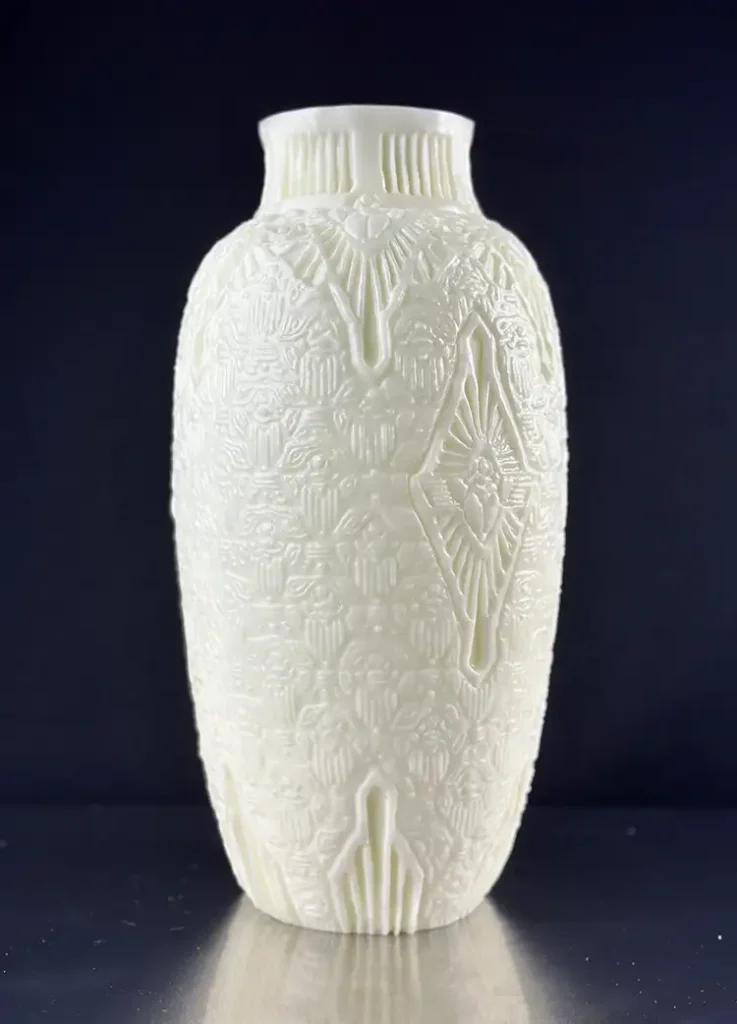
UV+EB Technology recently learned about one of the Budmens’ most ambitious projects: to use additive manufacturing to replicate a historic vase for the Everson Museum of Art in Syracuse, New York. This project called for meticulous attention to the artistic details and extraordinary patience, but these are standard operating procedures for Budmen Industries and Think Variant. Expecting a straightforward assignment, the Budmens instead discovered a project that demanded unconventional thinking, the ability to see in the dark and Think Variant’s most advanced production material and 3D printing method.
Capturing the Data
The Everson Museum sought to replicate Adelaide Robineau’s Scarab Vase, a landmark work of art, craft and technology. “The Scarab Vase was hand-carved by Robineau in 1910,” Isaac Budmen explained, “a task that took more than 1,000 hours. The vase has been untouchable for 116 years, behind glass, too fragile and precious to allow handling. The Museum asked us to change that by producing a faithful reproduction that could be touched.”
On arrival at the Museum to scan the vase for 3D replication, the Budmens were greeted with an intricate work of porcelain that featured mixed glazed and unglazed surfaces, but not anything they thought would be difficult to replicate. “We had been 3D scanning for years,” Isaac said, “We were confident. We knew what we were doing.” The Budmens staged two different scanning approaches to ensure a strong dataset: photogrammetry (photograph-based scanning) and infrared scanning.
Setting up in the Museum’s library, they used a Fujifilm X-T30 for photogrammetry, taking overlapping photos that would be matched by software to create a map of the vase in three-dimensional space. “This requires a methodical approach to capture every aspect of the vase in multiple frames from multiple vantage points,” Stephanie Budmen explained. “The photos capture color and texture data, yielding geometry and surface information for each frame. We mapped the Scarab Vase into five distinct elevations, using specific scanning strategies at each.”
For infrared scanning, a 3DMakerPro Whale was used. The Whale is a structured light scanner that uses a near-infrared (NIR) light source. It projects NIR patterns onto the object and reconstructs the geometry by measuring how those patterns deform across the surface.
“For this project, we used the lighting setup we had used successfully on other projects along with the ambient light,” said Stephanie. “We used the same scanning strategies that had yielded successful results. We spent 12 hours on site capturing multiple scans with both methods.”
Processing the Data
The Budmens then set to work processing the photographs and infrared scans. They used Agisoft Metashape software for photo alignment, camera calibration and refinement of the spatial data. Their photo software suite is a hybrid – photogrammetry combined with neural reconstruction to generate a detailed 3D model, with Metashape handling the filtering and refinement stages. The Budmens used JMStudio, 3DMakerPro’s proprietary software, for the raw infrared scan data.
To their surprise, data was missing. Whole chunks of detail on the carved scarabs that covered the entire vase had just vanished. “Our first scanning attempt of a porcelain vase with glazed and unglazed surfaces failed completely,” said Isaac. After much double-checking and reprocessing to no avail, the light dawned on them, literally. “The vase reflected and absorbed light in ways that destroyed our recorded data,” he said. “We had done the scanning in the Museum’s library, where there was a little natural light – just enough that if the light shifted even slightly, as available light often does, it changed the way light entered the porcelain and how it refracted. From photo to photo, from millisecond to millisecond of the infrared scan, we got vastly different data.”
The ambient light and the light from the infrared scanner had bounced off the embossed glazed surfaces, creating reflections everywhere, corrupting the dataset. “The very properties that make the Scarab Vase beautiful – the interplay of glazed and unglazed surfaces, the way light dances across the carved reliefs,” said Stephanie, “made it impossible to scan with our proven methods.” To eliminate the dancing light reflections, the Budmens arrived at an unconventional solution: “Maybe we could scan it in the dark,” she said. “It seemed counterintuitive – doing a 3D scan, a process that relies on light, in pitch-black conditions. But that was exactly what we needed to try.”
Capturing the Data, Round Two
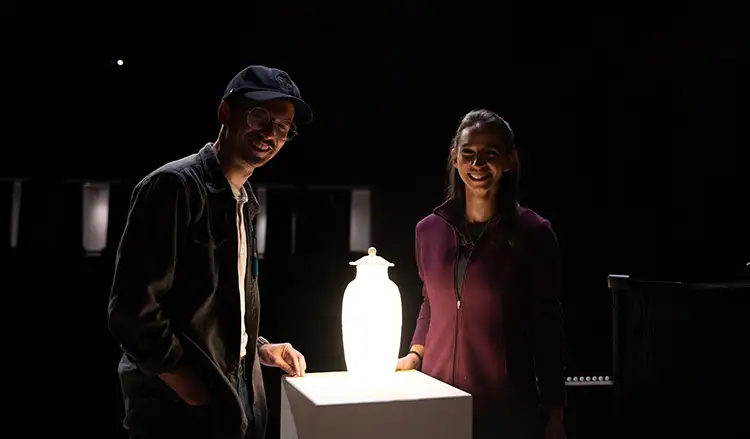
The Budmens went back to the museum to scan the vase again, but this time in total darkness. “For our second scan, we moved to the Museum’s auditorium,” Stephanie explained. “No ambient light. No windows. Pitch black. We now had precision control over the low levels of lumens needed for photogrammetry.” They ran the process again – photogrammetry scans and infrared scans – in near-complete darkness, with the only light coming from their scanning equipment.
By eliminating all other light sources, the Budmens had eliminated unpredictable reflections. “The glazed surfaces could only reflect our controlled scanning light,” said Stephanie. “The unglazed porcelain absorbed what it needed to absorb. Our processing steps revealed that, finally, the data was accurate, complete and clean.”
Fabricating the Replica
The Budmens would use the photogrammetry data to guide creation of the 3D-printed vase, with the NIR scans used as a baseline reference. After their scanning failure and subsequent success, the Budmens expected that fabrication of the vase – called the Please Touch version – would be straightforward. Instead, this task pushed the Budmens to the outer limits of their additive manufacturing capability. “The thousands of individually carved scarabs on the vase, each with relief detail, tested the limits of what typical additive technology and materials could produce,” Isaac said. “To achieve the results we needed, we turned to Think Variant to develop a custom material.”
“We got there after a lot of material exploration,” said Isaac. “Early on, we mixed ceramic powders into UV resins to use on the Elevate – our company’s own digital light processing (DLP) printer – to see if we could give the cured object some of the materiality of real porcelain.” They were not satisfied with those results and shifted toward SLA and a nylon-like resin formulation that could hold the vase’s surface detail while standing up to real-world handling. “The material qualities of our proprietary SLA resin were essential to replicating the surface character of the original vase,” he said. “This wasn’t just replication. It was translation – from atoms to ones and zeros and back to atoms again – with fidelity that honored Adelaide’s original craft.”
The final Please Touch vase was printed on a Stratasys V650, a commercial SLA system that uses a solid-state UV laser at 355 nm. Post-cure was in a water bath inside a UV chamber.
Isaac further described how SLA technology and the proprietary resin performed in producing an object with intricate details and mixed surface qualities. “This was one of the parts of the project that we found most interesting,” he said. “The original vase has highly polished glazed surfaces and unglazed recessed areas with a completely different tactile quality. SLA, and our resin in particular, captured both in a single print.” The geometry came through faithfully from the digitization pipeline, and the resin material’s response to laser curing produced distinct surface qualities in the raised and recessed areas that read as visually and tactilely different.
Results
The dual-surface nature of the original vase is exactly what derailed the Budmens’ first digitization attempt but, ironically, the problem cropped up upstream in the digitization process, not downstream in fabrication. “With glazed regions bouncing light and unglazed regions swallowing it, our dataset was falling apart in the middle,” said Isaac. “That’s what sent us back to the Museum to scan in a controlled light environment. Once we did that and had clean geometry data, the printer didn’t care which surface was which.”
“The result,” said Isaac, “is that people can hold and experience this piece of art history. The exhibition at the Everson Museum, called Touching History, now is open to the public.” The vase replica is one of the first of its kind, inviting the public to experience this work in a fully tactile way.
The Budmens’ experience using controlled-light scanning techniques to eliminate unwanted reflections may present an idea for dealing with reflective or translucent substrates.