


By Dr. Cristobal Garcia, senior scientist, Evonik Corporation
You are having a picnic in the park on a summer morning and notice that the grass has small droplets of water attached to the surface. Later, you walk around the pond and observe insects standing on the water and quickly gliding through it, you see a kid blowing soap bubbles, and you spot a runner stopping to use an asthma inhaler. You may not realize it, but all these things you observed are related to surface tension and wetting properties. The high surface tension of water makes it form spherical droplets in different substrates, ranging from grass to polymer films. The same tension of water allows some insects to stand on the surface without sinking, and these insects excrete a surfactant that quickly propels them through the surface. A surfactant in water helps to create bubbles due to the reduction of surface tension; it’s also a surfactant that helps to expand collapsed alveoli in our lungs when we are unable to produce our own natural surfactant. The principles that govern these examples are the same when printing inks are applied over any type of substrate. Hence, it is important to understand the effect of surface-active additives in a formulation to achieve an optimal printing process.
Surface Tension and Its Effects on Wetting
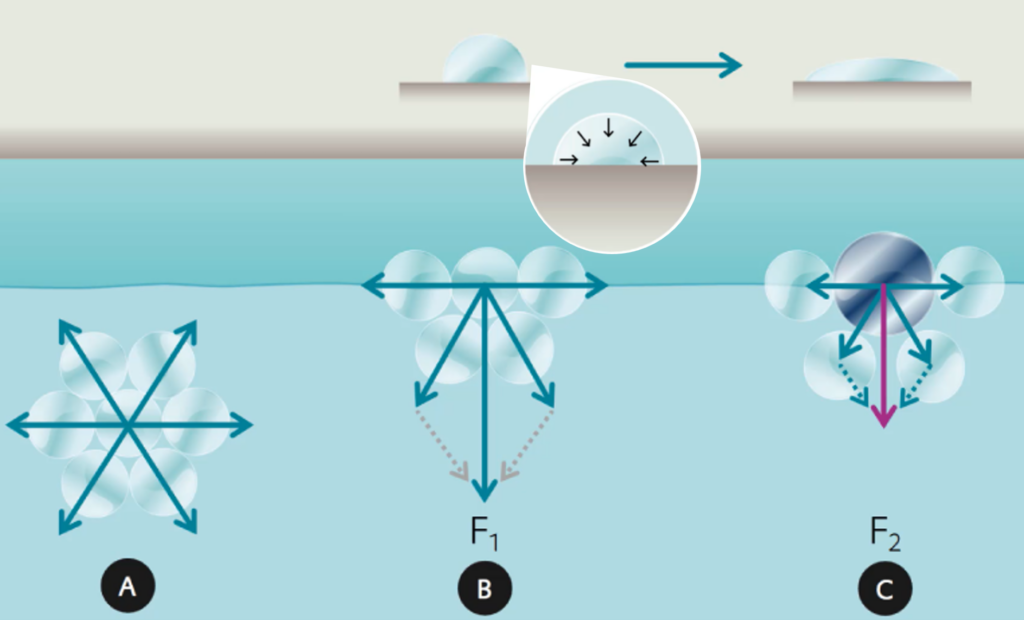
In a liquid, water for example, molecules in the bulk are surrounded by other molecules; the cohesive forces that hold the liquid together are in balance due to the symmetric interactions between these molecules (Figure 1A). In contrast, molecules at the surface are partially in contact with air; since the liquid-air interactions generally are weaker than the liquid-liquid interactions, there is an imbalance of forces and the bulk molecules pull the surface molecules inwards, creating a resultant known as Surface Tension (Figure 1B). Wetting could be improved by using surfactants. These are amphiphilic molecules (with polar and non-polar moieties) that migrate to the surface and orient their polar component toward water and the non-polar toward air. This reduces the resultant of the cohesive force pulling inwards, i.e., the surface tension is lowered (Figure 1C).
When a droplet of water is placed on a plastic substrate, it tends to contract into a spherical shape. This is because the cohesive forces of water are stronger than the attractive forces between the water and the plastic, rendering the droplet unable to wet the substrate effectively (Figure 1B, top). In other words, the Surface Tension is too high, and it will minimize the surface area by creating a sphere. When a droplet of surfactant-containing water is placed on the same plastic substrate, it tends to spread into an extended, nearly flat shape (Figure 1C, top). This happens not only because the surfactant reduced the extent of the cohesive forces on the water surface but also because the liquid is trying to minimize the tension on the substrate surface, also known as Surface Free Energy.
The concept of Surface Free Energy is similar to that of Surface Tension in liquids, arising from imbalanced forces on the solid’s surface. Since a solid cannot flow freely, it will reduce the excess of energy on the surface by attracting a liquid with weak cohesive forces. In other words, “A liquid will wet a substrate when the Surface Tension of the liquid is lower than the Surface Free Energy of the substrate.”
The above sentence, considered a rule of thumb for wetting, helps solve most problems in the printing industry that arise from current ink and substrate technologies. Although it is not the focus of this paper, one must keep in mind that the polar and disperse components of the liquid and the substrate must match; otherwise, inefficient wetting will arise even when this rule of thumb is satisfied.
Marangoni Flow, Surface Tension Gradients and Surface Defects
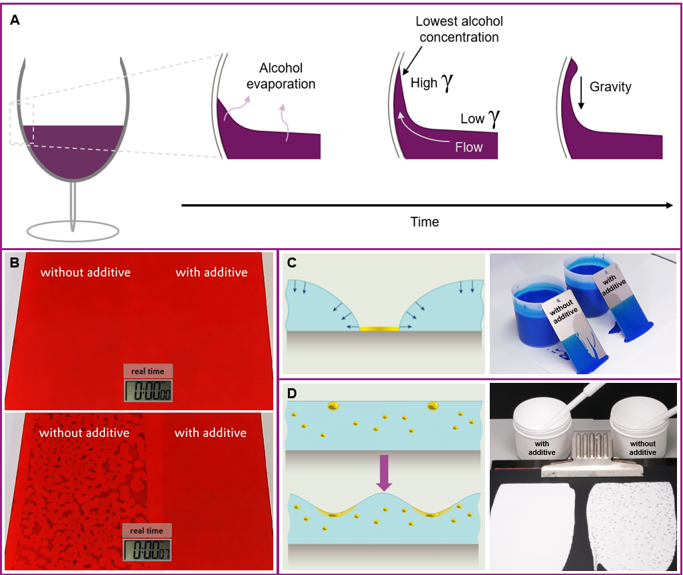
Have you ever enjoyed a glass of wine and then noticed droplets forming on the glass walls? These “tears of wine” are formed due to differences in surface tension that arise from the evaporation of alcohol at the meniscus where the wine touches the glass surface. When surface tension differences are present, a liquid will flow from lower to higher surface tension regions. This effect is known as Marangoni flow, in honor of Italian physicist Carlo Marangoni, who studied this phenomenon in the 19th century. In the wine example, as alcohol evaporates and water concentration increases, there is an increase in surface tension as well, which pulls the liquid upwards. Then, more alcohol evaporates, creating larger surface-tension gradients that pull more and more liquid up onto the glass surface until gravity pulls the liquid down again due to its own weight (Figure 2A). Another example is in the water strider mentioned previously; the insect can maintain its body on the water surface due to the high surface tension of water, and it can move quickly when it excretes a small droplet of a surfactant. The gradient of surface tension generated when the biosurfactant touches the water surface instantly pushes the insect toward a region with higher surface tension. 1
In coatings and printing inks, it is important to understand whether wetting problems emerge from differences in the ink’s surface tension and the substrate’s surface energy, low-surface-tension contaminants in the substrate or surface-tension differences due to additive incompatibility. In Figure 2B, an offset printing ink is overcoated with an overprint varnish (OPV). Both OPVs initially completely wet the substrate (top), but after seven seconds, the OPV without a wetting additive has contracted; meanwhile, the OPV with an additive maintains good film formation (bottom). Figure 2C shows a diagram with a contaminant preventing the efficient wetting of the substrate (left), and two metal panels partially contaminated with hydraulic oil and then submerged in inks with and without wetting additives (right); it is evident that the wetting agent helps to improve substrate wetting. Incompatible ink components (usually strong defoamers) create localized low surface tension regions, and the Marangoni flow pushes the ink toward regions of high surface tension (Figure 2D, left). This generates defects, such as orange peel or craters (Figure 2D, right). It is important to keep in mind that these defects occasionally are desired for special finishes, such as hammertone texturing. Adding incompatible additives promotes Marangoni flow in the surface to achieve the desired texture.
Wetting Agents for UV Systems
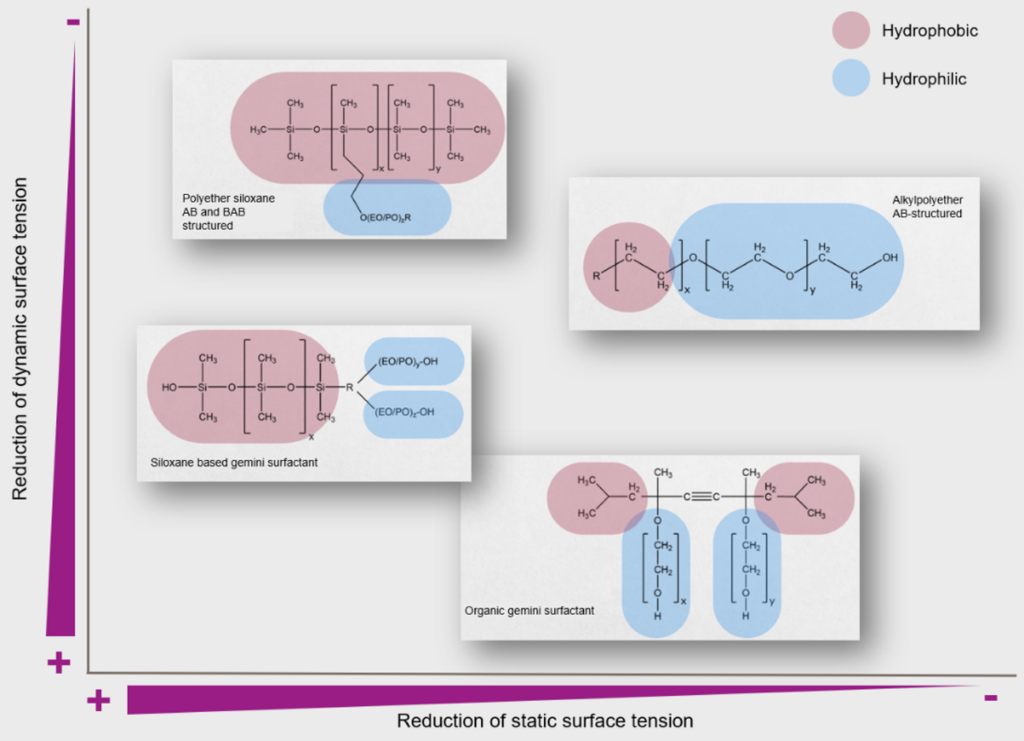
Thus far, surfactants have been defined as amphiphilic molecules that contain polar (hydrophilic) and non-polar (hydrophobic) moieties. However, the chemistries and structures used are plenty. Figure 3 shows the most common wetting agents used in ink systems and their effect in the reduction of both static and dynamic surface tension. Non-ionic alkylpolyethers (top right) are organic surfactants with high compatibility that normally are used in very sensitive water-based inks. Organic gemini surfactants (bottom right) are based on acetylenic chemistry; the triple bond reduces the possibility of twisting, making this surfactant unable to stabilize foam. Similarly, siloxane-based gemini surfactants (bottom left) have a low foaming tendency due to their characteristic structure. Finally, polyether siloxanes (top left) are the preferred type of surfactant for radiation curing systems and are the focus of this paper. The longer the siloxane chain, the higher the hydrophobicity and the incompatibility; the longer the polyether chain, the more compatible – although, in waterborne formulations, short siloxane chains are more effective, and in conventional acrylate UV systems, longer chains are preferred. Additionally, other properties, such as slip and tape release, are enhanced as polysiloxane chain length increases.
Incorporation of acrylate functionality to polyether siloxanes is a common strategy that enables anchoring of the surfactant to the cross-linked polymer matrix, preventing the migration of materials out of the cured ink, a very important property when it comes to food contact applications. The wetting performance of these acrylated surfactants varies as a function of the ratio of the polysiloxane and polyether repeat units. Long polyether content with short polysiloxane chains would be highly compatible with a modest effect on surface tension reduction. As the polysiloxane content increases, the additives will be very effective in surface tension reduction. When the polyether share is highly reduced and the polysiloxane length is increased, the additives will excel in slip and tape release properties up to the point where incompatibility will dominate and generate defects.
When it comes to printing over substrates with low surface energy, a primer not only helps to improve the adhesion and printing quality but also provides a more consistent surface energy when the variety of substrates to be printed on is broad. Some polyether siloxanes and their acrylated counterparts are excellent for improving the wetting of inks and primers over substrates with very low surface energy. To test this, a UV-curable white primer was formulated using different types of surfactants at 0.5 wt%, printed with a hand proofer (200 cpi/ 6.8 BCM) over metalized OPP, and cured with a Fusion UV Systems benchtop conveyor. The top picture in Figure 4 shows how the control with no wetting additives completely contracts. The first additive tested was a traditional alkylpolyether (PE-Alk); as mentioned before, these types of surfactants find application in water-based systems, and here it can be noticed that the improvement in wetting is minimal in the UV primer. The next additive is a conventional polyether siloxane (PS); the panel reflects the fact that the surface tension reduction is not enough to improve the substrate wetting. In contrast, the author’s company’s most recent development, PS-Neo, is a polyether siloxane carefully designed to offer an optimal solution for wetting difficult polymeric substrates. It is worth mentioning that the polysiloxane/polyether ratio of PS-Neo is higher than that of the conventional PS, which is consistent with the trends already described. Finally, the white primer in the last panel contains an acrylated polyether siloxane (PS-Ac D), which is highly effective in improving the wetting over the substrate.
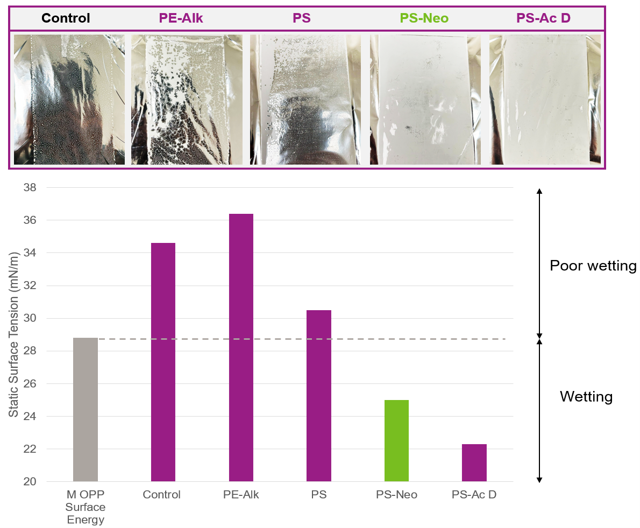
A quantitative demonstration of the “rule of thumb of wetting” is shown in the bottom chart in Figure 4. The static surface tension of the white primers is compared to the surface energy of the metalized BOPP (29 mN/m). The dotted line marks the limit below which the wetting is expected to happen. Noticeably, the two surfactants that showed improved wetting of the white primer over BOPP have a lower surface tension compared to the surface energy of the polymer film.
One may wonder which additive is the best to use when both referenced additives offer improved wetting. The first thing to keep in mind is that a very pronounced reduction in surface tension may result in overspreading of the ink, which in some cases can cause other problems, such as loss of edge definition. Thus, it may be more convenient to use a surfactant that is a couple of units below the substrate’s surface energy. Of course, other properties, such as long-lasting reduction of coefficient of friction (i.e. better slip), also should be considered as part of the selection process.
Reprintability is essential when formulating primers. This property enables the printing of another layer of ink on top without wetting issues. When wetting agents have a high polysiloxane content, the surface energy of the cured primer will remain low, preventing wetting by the next printed layer. In order to test the effect on reprintability of the studied wetting agents, the same primers were printed with a hand proofer (200 cpi/6.8 BCM) over Leneta charts and cured with the benchtop conveyor. A blue ink without wetting additives subsequently was printed on top using the hand proofer (600 cpi/2.5 BCM) and cured. The results are shown in the top picture in Figure 5. All the white primers show good reprintability, except the one containing PS-Ac D, which clearly prevents wetting of the cured primer. Once again, the quantitative results (bottom chart in Figure 5) show the “rule of thumb of wetting” to be true in this UV system. Here, the static surface tension of the blue ink without wetting additives (36 mN/m) is compared to the surface energy of the cured white primers. This time, the dotted line defines the limit above which reprintability is unaffected by the wetting additive used in the primer.
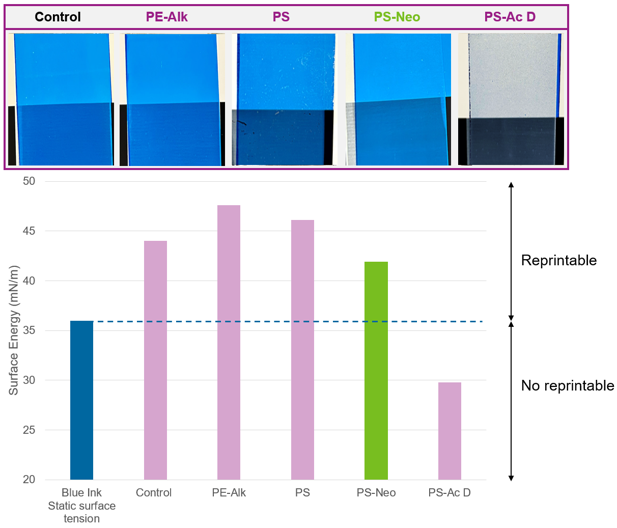
By combining both analysis of the liquid primer vs. the film substrate (Figure 4) and the blue ink vs. the cured primers (Figure 5), it is evident that PS-Neo is the only wetting agent that offers efficient wetting on low-surface-energy substrates while maintaining reprintability. From these results, it can be concluded that the addition of a wetting agent like PS-Neo has minimal impact on the cured primer’s surface energy, keeping it very similar to that of the sample free of wetting additives. As a final point, although PS-Ac D is not recommended for improving the wettability of primers over difficult substrates due to the reprintability challenges it may cause, it still is highly recommended for systems like overprint varnishes that may deal with wetting problems over other inks with low surface energy.
In summary, this work discussed the basic principles that govern substrate wetting and defect formation in terms of surface tension and surface energy. Hopefully, it will help the reader overcome wettability issues by applying the “rule of thumb of wetting” and find the best solutions to obtain an optimal print of energy-curable primers and inks over difficult substrates.
References
- B. Kwak, S. Choi, J. Maeng and J. Bae, „Marangoni effect-inspired robotic self-propulsion over a water surface using a flow-imbibition-powered microfluidic pump,“ Nature, p. 11:17469, 2021.

Dr. Cristo Garcia was born in Mexico City. He has a Bachelor of chemistry and a Masters in materials science and engineering from Universidad Nacional Autonoma de Mexico (UNAM). Dr. Garcia worked for almost five years at Sherwin-Williams Mexico as a senior chemist in the Product Finishes Division. He obtained a Ph.D. in materials science and engineering from the University of Delaware and currently is a senior scientist in the Printing Inks Group at Evonik. For more information, Dr. Garcia can be reached at email cristobal.garcia@evonik.com or visit www.evonik.com/en/company/worldwide-locations/north-america.html.