


Press release submitted on behalf of Boston Electronics.
Boston Electronics, Brookline, Massachusetts, a distributor of leading-edge electro-optic solutions, offers the uvLink family of wireless sensors and receivers for measuring irradiance and dose in UV and other spectral ranges. Designed for applications where wired connections are impractical, the system enables measurements in difficult-to-access locations, areas without infrastructure and environments where hazardous UV radiation limits personnel access. Wireless operation also allows sensors to move freely during measurement, including for production-line monitoring.
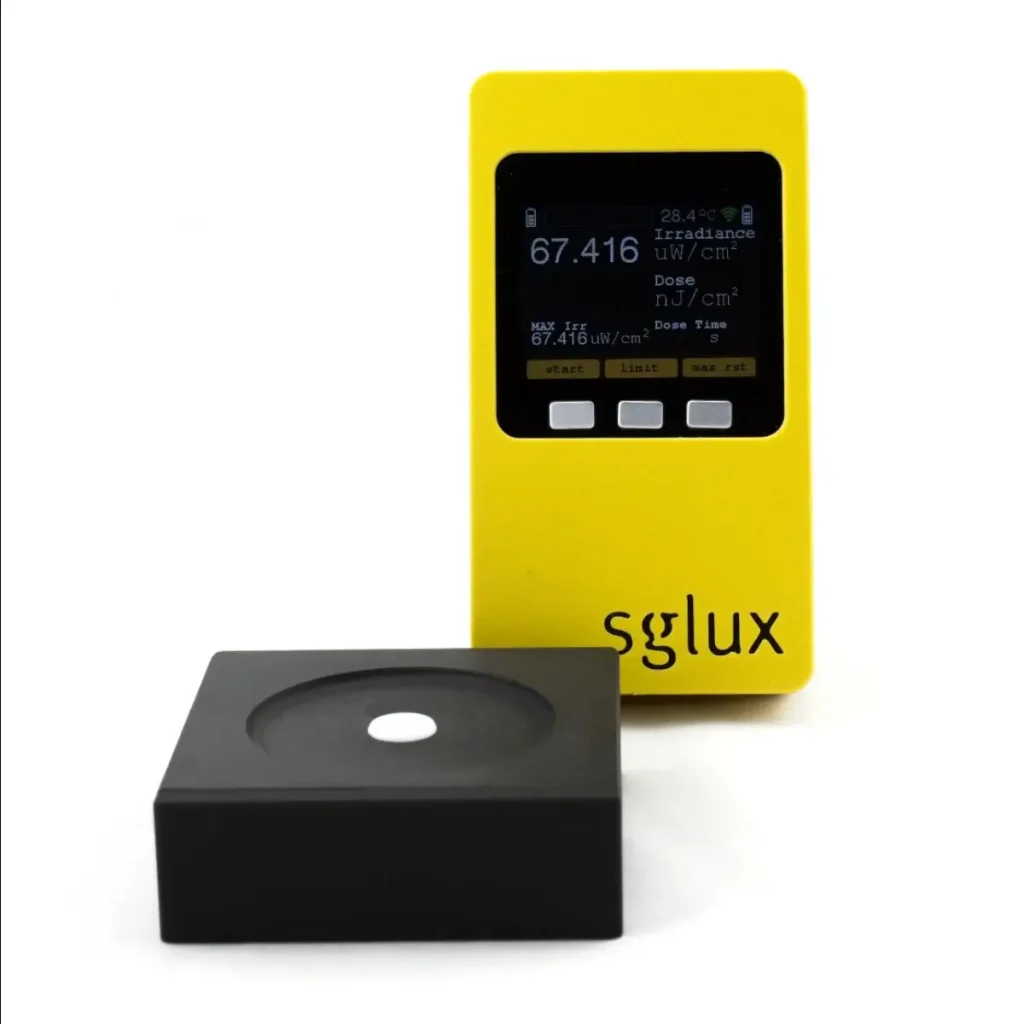
The uvLink family combines application-specific sensor nodes with receivers that function as stand-alone displays, data collectors or interfaces to computers and servers. Three products, uvLink One, uvLink Field and uvLink IoT, support individual measurements, simultaneous monitoring at multiple points and centralized evaluation of measurements from different locations.
Individual and Multipoint Measurement
The uvLink One pairs a wireless UV and temperature sensor node with a dedicated display. When one sensor node is within radio range, the system provides radiometer and dosimeter functions, allowing users to view irradiance, measure accumulated dose and monitor maximum irradiance. Connecting the display to a computer via USB enables data logging with the supplied uvLink log software.
For dose-based measurements, users can program a target dose before beginning a measurement. The instrument generates an audible signal when that target is reached. Dose measurements can be paused, resumed and reset through the display’s function keys.
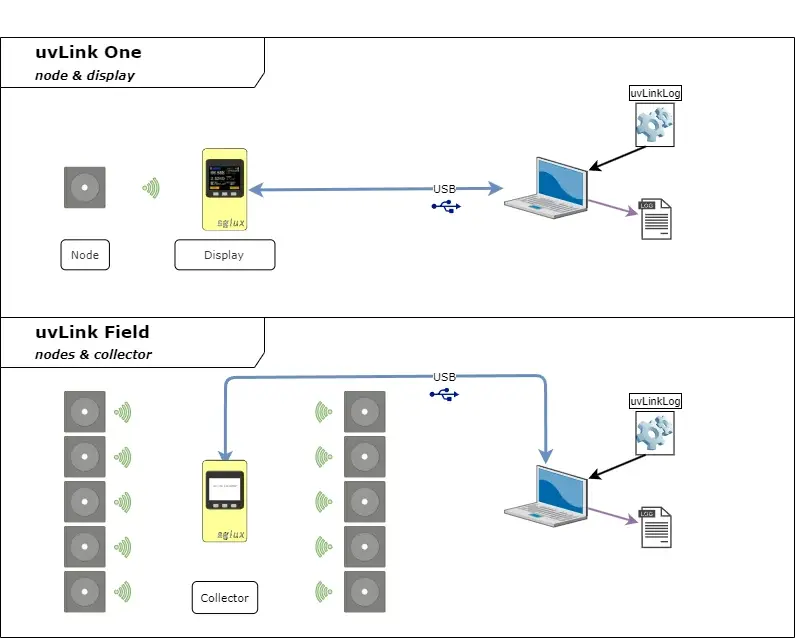
When two or more sensor nodes are within radio range, the receiver functions as a collector in the uvLink Field configuration. This arrangement supports applications that require simultaneous measurements at several points. The collector displays connected nodes and their current readings and transmits measured values to a computer via USB for logging and further processing.
Centralized Monitoring Across Distributed Locations
The uvLink IoT extends measurement capabilities to distributed locations. Multiple sensor nodes connect through a Wi-Fi network to an MQTT server, supporting centralized, real-time evaluation without requiring sensors to remain near one another or a local display or collector.
This configuration enables measurements from separate locations to be collected and evaluated centrally, expanding the system’s capabilities beyond local wireless monitoring.
Application-Specific Spectral Response and Calibration
Each sensor node is configured according to customer requirements. Available options include broadband UV, UVA, UVB, UVC, vacuum UV, far UV, UV Index, blue light and combined UV and visible ranges.
Silicon carbide photodiodes provide a suitable response for many UV measurement applications. Spectrally matched, filtered photodiodes are available when measurements must exclude other UV wavelengths emitted by the source. For measurements around 400 nm, including 395 nm LEDs, gallium phosphide photodiodes are used.
Each uvLink includes a customized, lamp-specific calibration traceable to PTB, along with expert support tailored to the application’s requirements. The uvLink One offers a dynamic range spanning five orders of magnitude, with the measurement range defined according to customer needs.
Rechargeable Operation and Flexible Sensor Placement
The uvLink One sensor node and display each provide approximately 10 hours of battery operation and can operate continuously when powered through their USB-C connections.
For more information, visit www.boselec.com.