


Submitted by Hoenle AG.
The converting and coating industry is undergoing a transformation: sustainability requirements, rising energy costs and the need for stable, reproducible processes are driving the move away from solvent-based systems. Conventional hot-melt PSAs have already established themselves as an alternative – but they reach their limits when it comes to precisely tailoring adhesive properties. UV-curable systems open up new possibilities here and are reshaping converting and coating processes.
The shift in adhesive technology is not a short-term trend, but the result of structural changes. In particular, the combination of regulatory pressure, rising energy prices and growing awareness of sustainability is forcing companies to critically examine and realign their existing processes. “A hot-melt adhesive contains no solvents and does not need to be dried – this saves enormous amounts of energy,” explains Melanie Ott, CEO of artimelt, a specialist supplier of hot-melt adhesives for industrial converting applications. “Particularly with the sharp rise in gas prices, this has become a decisive factor that has had a massive impact on investment decisions within the industry.”
Hotmelt PSAs as an Established Alternative
Against this backdrop, traditional hot-melt PSAs have become the norm in many applications. Not only do they enable more compact plant designs, but they also significantly reduce the complexity of the entire process chain. The elimination of drying sections leads to lower energy consumption whilst simultaneously simplifying plant design.
Whilst conventional coating systems with drying ovens can reach lengths of up to 50 metres, hot-melt systems are designed to be significantly shorter and more efficient. This has an impact not only on capital expenditure but also on space requirements in production, as well as on maintenance and operating costs. They also offer technical advantages. “Rubber-based hot-melts exhibit excellent low-temperature adhesion and adhere reliably to low-energy surfaces,” says Ott. These properties make them particularly attractive for applications such as labels on plastic substrates, where other technologies reach their performance limits.
Limitations of Classic Systems Become Apparent
However, as requirements increase, classic hot-melt PSAs are increasingly showing weaknesses in practical use. These are primarily chemical in nature, as the underlying rubber systems can only cover a limited range of properties. “Ultimately, the limitations lie in the rubber base itself,” explains Ott. “For example, temperature resistance, UV stability or even breathability can only be influenced to a certain extent – regardless of how much the formulation is optimized.” This becomes a particular problem in applications involving high thermal or mechanical stress. The process window also remains limited: whilst properties can be adjusted, they cannot be expanded at will. This leads to trade-offs between adhesion and cohesion, which can only be resolved within narrow limits.
Requirements Are Becoming Increasingly Differentiated
At the same time, the demands placed on modern pressure-sensitive adhesives are constantly rising. The range of applications is expanding, and with it the complexity of the required properties:
- For labels, for example, the focus is on reliable adhesion of the label to the substrate, particularly on challenging, low-energy surfaces such as PE or PP packaging (e.g. plastic bags or plastic bottles) as well as on glass and PET bottles. In addition, they often need to function at low temperatures or in damp conditions whilst simultaneously meeting regulatory requirements, such as those in the food sector.
- Adhesive tapes, on the other hand, must withstand mechanical stress and remain stable over long periods. Here, high cohesion, temperature resistance and resistance to environmental influences are paramount. Depending on the application, temperatures well above 80° C may be encountered.
- In the medical sector, further requirements come into play. “Here, it’s not just about adhesion, but also about skin compatibility and breathability,” explains Ott. “A modern plaster should adhere securely, yet be comfortable to wear and easy to remove – without leaving any residue.”
UV Curing as a Technological Step Forward
To meet these increasing demands, UV-curing hot-melt PSAs are increasingly coming to the fore. They are generally based on acrylate chemistry and enable targeted cross-linking of the polymer chains during the coating process.
UV irradiation creates a three-dimensional network that significantly improves the adhesive’s mechanical properties. “Cross-linking massively increases cohesion, as well as temperature resistance,” explains Ott. “At the same time, acrylate chemistry brings additional benefits such as UV stability and breathability.”
A key advantage lies in the ability to precisely control the properties during the process. “We can use the UV dose to precisely adjust the degree to which a system is crosslinked,” adds Christian Fischer, head of marketing & communications at artimelt. “This means that greater cross-linking increases internal cohesive strength, whilst reducing tack and peel adhesion. Conversely, lower cross-linking has the opposite effect.”
Process Control Becomes a Key Success Factor
For this potential to be realized in practice, process equipment plays a central role. Modern UV systems enable precise control of radiation intensity depending on machine speed, thereby ensuring stable process conditions. In practice, for example, UV curing systems from Hoenle are used; the company is a specialist supplier of UV curing systems and plant concepts for hot-melt processes in the converting industry. Users make use of the adjustable and precise control offered by these systems to reproducibly set the desired adhesive properties. “The dose is determined by the intensity and dwell time – and this depends directly on the speed of the line,” explains Volker Selg, Senior sales engineer at Hoenle. “Modern systems automatically adjust the output, thereby ensuring constant conditions throughout the entire process.”
Another key factor is the homogeneity of the irradiation. Particularly with wide webs, it is essential to achieve uniform intensity across the entire substrate width in order to ensure consistent product properties. “It is therefore now possible not only to set the parameters precisely, but also to monitor them continuously,” adds Selg. “In-line measurement systems detect changes such as lamp ageing or contamination at an early stage and enable continuous readjustment.”
In Practice: The Interplay Between Material and Equipment
In practice, performance is achieved through the targeted coordination of formulation and the UV process: artimelt develops application-specific hot-melt PSAs, whilst Hoenle supplies and configures the corresponding UV curing systems so that the desired properties can be reproducibly achieved.
To ensure maximum performance of the end product, the key is precise adaptation to the specific application. Different requirements call for different technological approaches, which must be combined in a targeted manner. “The decision on which system to use is not a question of cost, but a question of requirements,” emphasizes Ott. “Which technology is better always depends on the specific application and which properties are the priority.”
For example, traditional hot-melt PSAs remain the first choice for applications with high demands on cold-bonding performance. UV-curing systems, on the other hand, demonstrate their strengths at high temperatures, under mechanical stress and in outdoor applications.
Efficiency Gains and New Possibilities
UV-curing hot-melt PSAs offer additional flexibility in the process, as the balance between adhesion and internal strength can be precisely and reproducibly adjusted to a specific application via the UV dose. The elimination of drying sections is a general advantage of hot-melt technologies and applies to both conventional and UV-curing systems. “UV-based processes, however, go a decisive step further: the downstream UV cross-linking broadens the application window and enables stable and reproducible processes even with higher film thicknesses and more demanding applications,” adds Selg.
This results in advantages in terms of line speed and process stability, particularly when compared with solvent-based systems. Whilst physical limitations such as drying capacities or explosion protection play a role in the latter, UV-curing systems allow for significantly more flexible process control. At the same time, however, it remains crucial to note that the speeds achievable depend heavily on the specific application and the system being compared.
Regardless of this, hot-melt technologies open up entirely new possibilities for processing demanding substrates. “With porous materials such as textiles or foams, the adhesive remains on the surface and does not penetrate uncontrollably,” explains Ott. This makes it possible to create material combinations that can only be achieved to a limited extent with liquid systems.
Safety benefits must also be taken into account: the absence of solvents eliminates potential emissions and reduces the risk of explosion. This not only simplifies plant operation but also significantly reduces the effort required for safety and regulatory compliance measures.
Conclusion: Precise Process Control as the Driver of Technological Change
The shift from solvent-based adhesive systems towards hotmelt and, in particular, UV-curing technologies is the result of clear industrial requirements: higher energy efficiency, stable processes and precisely adjustable product properties. Traditional hot-melt PSAs have played a key role in driving this change, but are increasingly revealing their inherent limitations as performance requirements rise.
UV-curable hot-melt PSAs significantly expand this spectrum, as they not only enable better material properties but, above all, allow for precise control during the ongoing process. It is only through the combination of application-specific formulation and precisely controlled UV dose that it becomes possible to specifically balance adhesion, cohesion and temperature resistance.
In practice, it is evident that the real added value lies not solely in material innovation, but in the coordinated interplay between adhesive chemistry and process technology. Suppliers such as artimelt, with their formulation expertise, and Hoenle, with their precisely controllable UV curing systems, exemplify how these two worlds can be efficiently brought together in industrial applications.
As a result, UV-curing hot-melt PSAs are emerging as a key technology for demanding converting applications – particularly in areas where the performance limits of conventional systems are becoming apparent and, at the same time, the highest demands are placed on efficiency and process reliability.
More information on www.hoenle.com and www.artimelt.com.
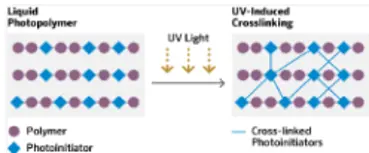
Caption: Illustration of UV-Induced Polymer Crosslinking
Picture: artimelt
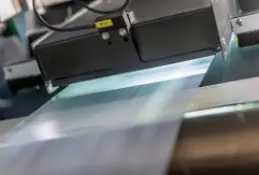
Caption: Illustration of UV-Induced Polymer Crosslinking
Picture: artimelt
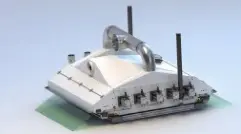
Caption: Technical Visualization of a UV-Curing Chamber from Hoenle
Picture: Hoenle
Note: The photographic and graphic material may only be published in connection with the associated technical article.
About Hoenle:
Hoenle AG is the parent company of a group of UV specialists and one of the world’s leading suppliers of industrial adhesives and UV Technology. The publicly listed company is based in Gilching / Munich and develops, manufactures, and markets UV/LED-UV systems and equipment, UV lamps, and UV measuring technology for various application fields worldwide. The business is divided into three units:
The Business Unit Curing develops, produces, and distributes curing and drying technology for industrial printing, converting and coating applications. The product portfolio comprises systems and solutions based on UV, LED-UV, IR/hot air as well as inert UV systems and peripheral equipment.
The Business Unit Disinfection offers system solutions for disinfecting air, water and surfaces with UVC and xenon pulsed light as well as microbiological analyses, which are used in the food industry, for example. An in-house lamp production facility supplies customer-specific lamps.
The Business Unit Adhesive Systems comprises solutions for bonding applications in industrial manufacturing processes. These include adhesives and sealants as well as suitable UV and LED-UV curing devices.
In addition to international subsidiaries in China, Korea, France, Great Britain, Austria, Malta, and the USA, as well as a sales office in Italy, the group has a dense network of distribution partners worldwide.
A comprehensive service offering, consisting of service technicians stationed around the world, decentralized spare parts warehouses and the option of augmented reality-based remote service, ensures that customers’ production processes are sustainably supported.
About artimelt:
artimelt AG is a highly specialized supplier of hot-melt adhesives focused on demanding industrial applications. The company develops and manufactures customized pressure-sensitive adhesive systems based on rubber and acrylate chemistry, which are specifically tailored to meet the unique requirements of sectors such as labeling, adhesive tapes, and technical applications. A particular focus is on the development of UV-curable hot-melt PSAs, which offer greater flexibility in adjusting adhesive properties.