
By Jennifer Heathcote, vice president, Business Development, GEW (EC) Limited
UV curing is an environmentally friendly processing tool that allows manufacturers to instantly set inks, coatings and adhesives that have been applied to a web, sheet or part without the aid of solvent or water-based carriers. Since the carrier is eliminated, there is no need for evaporation using long, energy-consuming, thermal drying ovens or afterburners in the case of solvents. As a result, UV curing, which generally emits no greenhouse gasses (GHGs), no volatile organic compounds (VOCs) and no hazardous air pollutants (HAPs), reduces a company’s Scope 1, 2 and 3 emissions. Upon exposure to UV energy, the formulation is fully set and immediately ready for post-cure processing and shipping. For these reasons and more, manufacturers around the world integrate UV lamp heads into a wide range of applications. Every day, UV technology is used to cure primers; graphics and text; silicone release coatings; UV acrylic hotmelt; syrup adhesives; protective, tactile and decorative varnishes and lacquers; industrial paints and other functional coatings.
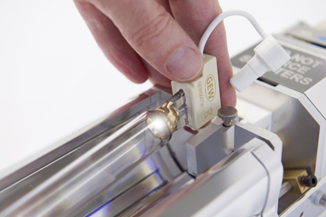
 An ultraviolet curing lamp is classified as either an electrode arc or microwave. Both types contain somewhere between 20 and 200 mg of mercury. For comparison, a dental amalgam tooth filling contains an average of 800 mg of mercury and can contain as much as 1,000 mg. While use of dental amalgam is heavily restricted in Europe, it is widely used elsewhere and represents the largest use of elemental mercury in a commercial product. In fact, a 2020 EPA report stated that dental amalgam accounts for 46.8% of the total elemental mercury used to make products sold in the US annually, with over 100 million dental amalgam fillings placed in the US every year.
The exact amount of mercury within a UV lamp varies based on lamp design, power and length and is a trade secret of the manufacturer. When mercury inside a lamp is vaporized into a plasma gas using either a voltage arc or microwave energy, the lamp emits a combination of ultraviolet, visible and infrared wavelengths. No other gas discharge material produces the same spectral output as mercury. Since the 1940s, UV-curable chemistry intentionally has been formulated to react to the broad-spectrum output generated by vaporized elemental mercury. Commercially available UV LED curing systems do not have the same spectral output and, therefore, are not a direct replacement.
Restriction of Hazardous Substances (RoHS)
Restriction of Hazardous Substances (RoHS) is a European directive adopted by the European Commission (EC) and its 28 member nations in 2003. It was revised in 2011 and is amended regularly with additional directives. For those outside Europe, an EC directive is a legislative act defining a specific goal that all European Union countries are obligated to achieve. Once a directive is published, there is a short window during which each EU country must enact national legislation making it compliant with the directive.
The RoHS directive regulates the use of hazardous substances in electrical and electronic equipment (EEE), as well as the subsequent waste stream of electrical and electronic equipment (WEEE). Specifically, RoHS restricts all manufactured EEE products from exceeding specified maximum concentration values for 10 defined substances. Mercury is one of the restricted substances and is limited to a maximum of 0.1% by weight in any homogeneous material.
Annex I of RoHS defines categories for EEE. Annex II specifies the maximum concentration values for the 10 restricted substances, and Annex III lists approved exemptions to Annex II restrictions. Article 5 of the directive allows for periodic review and revisions to Annex III exemptions.
Medium-pressure mercury vapor lamps are classified in Annex I as Category 5 Lighting Equipment. Until 2021, UV lamps were subcategorized in Annex III as 4(f), which was a catch-all for all lamps not specifically referenced elsewhere in Annex III. Following the most recent 2021 review, 4(f) was expanded into four new and distinct categories with 4(f)-IV created to capture all mercury-containing, medium- and high-pressure lamps that emit light in the ultraviolet spectrum. 4(f)-IV remains an incredibly broad category. According to Lighting Europe, 1 it includes 15 general application categories, each of which could be further expanded into subcategories. These categories are as follows:
- Curing, disinfection, sterilization and other photochemical and photobiological purposes (e.g., photooxidation)
- Treatment of zoo mammals and birds, daylight simulation, tanning and similar applications
- Curing of inks in printing systems and the hardening of adhesives and silicones
- Disinfecting surfaces, water and air
- Ballast water disinfection
- UV curing of composites, automotive coatings, glass and plastic decoration
- Wood treatment
- Photolithography in semiconductor manufacturing, specifically i-line photolithography to pattern intricate features on substrates across a wide range of device applications
- Wafer edge exposure step after photolithography patterning
- Photo-stabilization in semiconductor manufacturing
- Production of electronic components and printed boards
- Medical, industrial, and research and development applications, including testing, inspection, measurements, qualitative and quantitative analysis, and utilizing specific wavelengths
- Production of active pharmaceutical ingredients
- UV Absorbance Cell (UV-VIS, chromatography, pharmaceutical purification and analysis)
- Water line quality analysis (total organic carbon TOC analysis)
Only individuals intimately familiar with one or more of these applications have the specific knowledge to grasp the viability of alternatives and the consequences of eliminating mercury vapor UV lamps. While several applications are transitioning all or part of their processes to LED technology or other alternatives, it is simply not possible for those who have successfully developed a solution in one application area to claim that the same can be done for the others. No one has a full understanding of the combined impact on all markets, as there is very little overlap of suppliers and end users. The companies associated with these diverse applications and markets are siloed from one another. Furthermore, the specific uses of UV technology are radically unique, making a universal LED solution that would be equally deployable for all applications impossible.
A complete and total restriction of 4(f)-IV would have a disruptive and unequal impact on each of these 15 applications due to insufficiently established alternatives. As a result, further regulation of 4(f)-IV lamps requires segmentation into subcategories. It is only through the addition of subcategories that the EC can obtain a clearer picture and effectively can begin restricting lamps for specific applications where established alternatives exist. Expanding 4(f)-IV is the next step for RoHS. In fact, this is exactly what RoHS did for general lighting. It is reasonable to expect UV lamps to be treated similarly.
Environmental Impact
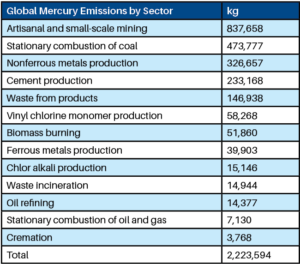
Lighting Europe reports that for all lamps classified as 4(f)-IV sold to companies involved in the 15 previously listed application categories, the EU places just 206 kg of mercury onto the market annually. This quantity is based on a MELISA model conducted in 2018. The most current UN data on annual global mercury emissions of 2,223,594 kg was published in 2018 using data collected in 2015 (Table 1). According to the UN, the greatest mercury emissions arise from artisanal and small-scale gold mining, the stationary combustion of coal, non-ferrous metals production and cement production. Mercury vapor UV lamps do not register as their own category and are captured as a minuscule portion of waste from products and waste from incineration.
If all the mercury contained in the entire supply of 4(f)-IV lamps placed on the EU market annually for all 15 application categories were released entirely into the atmosphere, it would represent just 0.009% of all global mercury emissions each year. This is 206 kg divided by 2,223,594 kg and represented as a percentage. Due to recycling, only a small percentage of mercury from UV curing lamps is released to the atmosphere, making the contribution to the biosphere from broken or spent curing lamps effectively zero. As a result, restricting the use of mercury vapor lamps would have a negligible impact on mercury in the biosphere while potentially resulting in a negative commercial and technical situation for numerous industries. The preferred solution that protects the biosphere without excessively burdening businesses is lamp recycling.
RoHS 4(f)-IV Exemption Review Process
Manufacture, importation, exportation, shipping and the use of medium- and high-pressure mercury vapor UV curing lamps within the EU for lamps categorized in Annex III under 4(f)-IV are exempt from RoHS restriction through February 24, 2027. This is per the amendment, Directive (EU) 2022/287, published December 13, 2021, which can be downloaded from the link noted at the end of this article. 3
While many individuals and companies claim that mercury vapor lamps are banned when the amendment exemption expires, the reality is that this date simply is the date by which the EU is required to re-evaluate whether the exemption should expire, be extended or require a new amendment. Until the EC issues a new RoHS directive in 2026 or early 2027, all predictions on the future status of mercury vapor lamps beyond the expiration date are pure speculation.
The 2026 review period for 4(f)-IV now is underway. In anticipation of the expiration, the EC appointed the Oeko-Institut 4 to review the commercial uses of mercury vapor lamps and to recommend whether the exemption should be expired, be extended or be subject to further clarification via additional subcategories. The EC will consider The Oeko-Institut’s recommendations but is the sole decision maker on new RoHS amendments.
The deadline to submit dossiers to the Oeko-Institut, making the case for or against extending exemption 4(f)-IV beyond the 2027 expiration date, was August 24, 2025. Lighting Europe submitted a dossier on behalf of all lamp manufacturers and users, recommending that the extension be granted an additional five years. In past reviews, the German mechanical engineering association VDMA 5 also submitted a dossier in support of an extension. It is not yet known how many dossiers were submitted this time. All submissions currently are under review and will be posted online in 2026. 6
In spring or summer 2026, stakeholders located in Europe, selling into Europe, or purchasing equipment or manufactured products from Europe will be able to review the approved dossiers and submit public comments. 6 Please note that the comment period is very brief, lasting six weeks or less. All stakeholders are encouraged to submit comments in favor of or in opposition to the dossiers to ensure the committee is aware of how the technology is being used and whether viable alternatives exist. Approximately 170 stakeholders operating within the 15 application categories submitted comments in 2021. The number is expected to be greater in 2026 due to increased awareness of the process. The Oeko-Institut will review all public comments and make a recommendation to the EC in late 2026. The EC then will issue a directive in late 2026 or early 2027 updating 4(f)-IV and clarifying restrictions on UV lamps.
Outcomes of Previous Reviews
The RoHS exemption review process for UV curing lamps has occurred every five years, with the most recent reviews conducted in 2011, 2016 and 2021. In each case, an exemption for UV curing lamps was deemed reasonable by the EC and renewed for an additional five years. The EC justified its decision in 2021 based on the following three factors:
- Elimination or substitution via design changes or materials and components which do not require any of the materials or substances listed in Annex II is scientifically or technically impracticable.
- Reliability of substitutes is not ensured.
- Total negative environmental, health and consumer safety impacts caused by substitution are likely to outweigh the total environmental, health and consumer safety benefits thereof.
The final report, Study to assess requests for renewal of 12 exemptions to Annex III of Directive 2011/65/EU, can be downloaded via the link in Resource 7, noted below.
The justification to exempt lamps in 2021 equally applies in 2026. As a result, the EC is likely to issue another five-year extension through 2032. While alternatives to mercury vapor lamps exist, such as UV LEDs, it is not yet possible to swap UV LEDs for mercury vapor lamps in all established processes within the 15 application categories. With respect to UV LEDs, the associated uses have been evolving since 2004, and the technology will continue to evolve over the coming decade. It is only when LEDs or other alternative technologies are proven to be technically, practically and economically viable for most, and preferably all, applications that mercury lamps can be broadly restricted from use. The more likely scenario is that various subcategories will be created under 4(f)-IV, and very specific uses of mercury vapor lamps will be restricted as solutions are proven viable. This entire process is likely to take 10 to 15 years or more.
Prematurely restricting UV lamps will have a negligible impact on the environment due to current mercury quantities amounting to significantly less than 0.009% of all emissions annually and will be overly burdensome on businesses without alternatives. In the meantime, users with access to alternative technologies are highly encouraged to migrate away from mercury vapor lamps. All others should properly dispose of spent lamps through established recycling channels, continue innovation efforts to establish workable alternatives that do not require mercury and submit public comments to the 4(f)-IV review committee when the window opens in 2026.
Companies around the world are encouraged to monitor the RoHS exemption review process and any resulting directives. In addition, any individual or company that uses UV curing systems within the EU; purchases or sells UV systems, UV lamps, or machines containing UV systems from or into Europe; or sells finished goods manufactured with UV curing into Europe, is a stakeholder and can participate in the public comment period. It is worth noting that in 2021, a paltry 29 out of 170 companies that submitted public comments were involved in UV curing. Fortunately, the industry is much more aware of the review process than in previous years. As a result, participation levels are expected to be significantly greater this time. Readers are encouraged to stay tuned and fully participate when the public comment period is open.
Originally published in Converting Quarterly. Reprinted with permission.
 Jennifer Heathcote is vice president of business development at GEW (EC) Ltd. For more information, email jheathcote@gewuv.com or visit www.gewuv.com.
Resources
- lightingeurope.org
- https://app.mapx.org/static.html?project=MX-IY9-QCF-ILZ-UVO-07Y&views=MX-NUMTV-X97MG-7POZ1&lat=14.978&lng=16.762&z=1.5&theme=color_light
- https://eur-lex.europa.eu/legal-content/EN/TXT/PDF/?uri=CELEX:32022L0287&from=EN
- oeko.de/en/
- vdma.eu
- https://rohs.exemptions.oeko.info/news
- scycle.info/wp-content/uploads/2023/05/RoHS-28_Pack-23_Report_Final_20221220-low.pdf