


By Delphine Kimpel, BASF SE; and Jonathan Wattras and Mervin Wood, BASF Corporation
The light stabilization of coatings has been a challenge for many years in the paint industry. Over four decades ago, it was discovered that hindered amine light stabilizers (HALS) play a significant role in the light stabilization of polymers and resin binders. Typically, these compounds are derivatives of 2, 2’, 6, 6’-tetramethylpiperidine and, when exposed to peroxy radicals, are oxidized to produce stable nitroxides. This reaction, in addition to the scavenging of alkyl radicals by the nitroxides, forms a cycle describing HALS as a class of excellent polymer and resin binder stabilizers, which can be used to extend useful coating lifetimes. This paper discusses how the weathering performance of UV-curable clearcoats can be improved significantly by using the correct light stabilizer package, an optimized photoinitiator combination and binder selection.
Introduction
UV absorbers (UVA) used in coatings should meet certain criteria, which can be categorized into primary and secondary requirements, as detailed below. Primary requirements include a high extinction coefficient, broad spectral coverage between 290-380 nm, a steep absorption curve and photochemical stability. An effective UV absorber must absorb UV light faster and more readily than the polymer it is meant to stabilize and dissipate the absorbed energy before unwelcome side reactions can occur. Secondary requirements for a UV absorber include excellent solubility in UV-curable formulations, preferably a liquid; ease of incorporation into solvent-free systems; good heat resistance; no unwanted side reactions with other components or catalysts which may be present; good compatibility in the polymer and resistance to extraction. 1-4
Sterically hindered amines light stabilizers (HALS) have been used since the early 1970s to stabilize polymers and resin binders on a commercial scale. These substances function as radical scavengers in the autoxidation cycle and inhibit the photo-oxidative degradation of polymers. The mode of action of HALS largely are independent of the film thickness applied, which means they also can act at the coating surface where the ultraviolet absorbers provide minimal protection from UV light. In clearcoats, HALS protect against surface defects such as gloss loss or cracking, whereas in pigmented coatings, chalking and discoloration can be prevented. These surface defects eventually lead to increased water permeability and loss of physical and protective properties, resulting in substrate erosion. 4
UV-curable coatings have become an important segment in the coatings market since they are fast curing and can be cured at low temperatures. 5 UV-curable coating formulations require energy directly from UV sources to initiate the photocuring mechanism of the monomers and oligomers present in the formulation. Photoinitiators generally absorb UV light in the 300-400 nm region to initiate the photocuring mechanism, while UV absorbers that are present in the formulation absorb in the same UV region. Additionally, HALS are radical scavengers and, as such, can interfere with the curing mechanism of UV-curable coating formulations. Therefore, when incorporating UV absorbers and HALS into photocurable coating formulations, it is essential to carefully select the UV absorbers, HALS and photoinitiators so that curing and lightfastness are not impacted negatively.
In previous work, it was described how various water-borne urethane acrylate dispersions could be photocured and photostabilized. 6-8 A particularly effective strategy for photocuring was described to use two or more photoinitiators. The individual photoinitiators target specific regions (surface and bottom) of the coating film. Short-wavelength absorbing photoinitiators were found to effectively cure the top coating surface. On the other hand, a long-wavelength absorbing and photobleachable photoinitiator can be effective for deep through-curing. Examples of the common photobleachable, long-wavelength absorbing photoinitiators were mono-acylphosphine oxide (MAPO) and bis-acylphosphine oxide (BAPO), which also absorb into the early visible light region 400–430 nm. Photoinitiators that work well to cure the surface include aromatic alpha-hydroxy ketones (AHK) and mixtures of benzophenone/AHK. 9 To ensure good through-curing, arylphosphine oxide photoinitiators can be employed. 10 Deep through cure was particularly critical for coatings that contained UV blocking materials (light stabilizers and/or pigments/fillers). Water dispersible benzotriazole (BZT) and polar hindered amine light stabilizers (HALS) were found to be useful in these early studies. 6-11
A shift to UV-curable coating technologies to reduce volatile organic compounds (VOCs) is pushing resin and additive suppliers to develop novel materials or methods to incorporate these hydrophobic materials into low-VOC formulations while maintaining desirable coating properties. 12 Some weathering results for UV-curable formulations have been shown to be at least comparable to those obtained with thermally cured systems. 13 Although many of the latest low-VOC technologies have overcome the disadvantages associated with traditional solvent-based systems, UV absorbers and HALS are still required to avoid coating degradation from sunlight exposure and improve weathering stability. Hindered amine light stabilizer, UV absorber, UV-curable oligomer and reactive diluent selection for UV-curable formulations that provide excellent weathering protection from the deleterious effects of UV light due to weathering will be highlighted.
Experimental Material and Methods
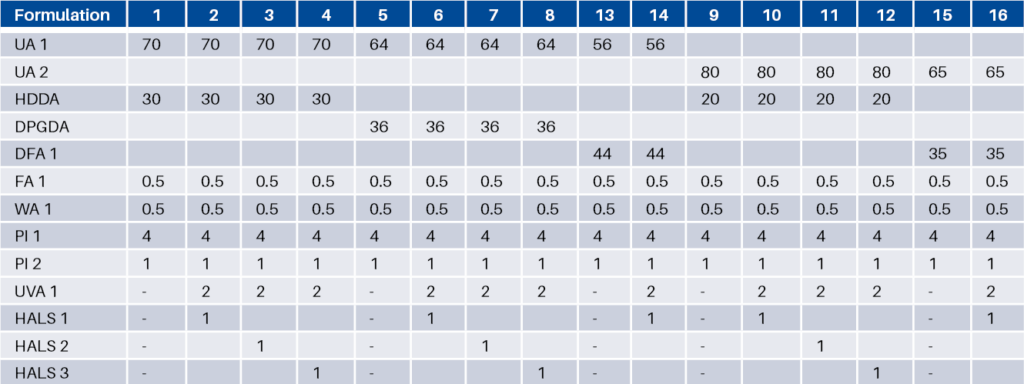
UV-curable formulations were prepared according to Table 1. Unless otherwise stated, all UV-curable formulations contained a hydroxyphenyltriazine UV absorber (UVA 1) at 2 wt% relative to total resin solids. A triazine UV absorber was selected since it provides greater photopermanence and since its absorption cut-off is at a lower wavelength than a standard benzotriazole UV absorber. Thus, more UV light can be absorbed by the photoinitiator, and better through-curing can be achieved. All UV-curable formulations used the following photoinitiator package: 1-hydroxycyclohexylphenyl ketone at 2 wt% plus benzophenone at 2 wt%, both of which are shown in the Table 1 as PI 1 and ethyl (2,4,6-trimethylbenzoyl) phenylphosphinate at 0.91 wt% plus phenylbis (2,4,6-trimethylbenzoyl) phosphine oxide at 0.09 wt%, both of which are shown in Table 1 as PI 2, all relative to total resin solids. Unless otherwise stated, all UV-curable formulations contained a hindered amine light stabilizer, either HALS 1, HALS 2 or HALS 3 at 1 wt% relative to total resin solids. Urethane acrylates were chosen as the UV-curable oligomers under study since this product family, as a class, has pronounced toughness and flexibility, non-yellowing and good weathering resistance. 14 The reactive diluents, HDDA, DPGDA or DFA 1, were added to either UA 1 or UA 2 in a certain weight ratio to yield a viscosity of 1 Pas. DFA 1 is a hydrophobic difunctional monomer based on propoxylated (2.0) neopentylglycol diacrylate. The UV-curable oligomers used in this study were UA 1, which is considered a flexible urethane oligomer, and UA 2, which is a harder urethane oligomer. FA 1 was added as a flowing and leveling agent, while WA 1 was added as a wetting agent.
UV-curable clear formulations were prepared and applied over a white coil coating on aluminum using drawdown rods. Formulations were cured using a mercury lamp at 120 Watts/cm at a line speed of 10 meters/minute. All UV-cured films had a dry film thickness of about 40 microns.
Accelerated weathering tests were performed in an Atlas Weather-Ometer® device, according to the DIN EN ISO 16474-2 protocol. Test conditions were: inner and outer borosilicate type S filters, 102 minute light and dry, Black Standard Temperature (BST): 47 ± 3° C, Probe Room Temperature (PRT): 30 ± 2° C, relative humidity: 40 ± 5%, followed by 18 minute light and front spray, BST: 47 ± 3° C, PRT: 30 ± 2° C, relative humidity 40 ± 5%. The output of the Xenon lamp is 0.51 W/m2 between 300 and 400 nm. CIE Lab Delta E (∆E) and 60° gloss were measured at various intervals during accelerated weathering.
Results and Discussion
Immediately after photocuring, all formulations showed a b* value (which defines the degree of yellowing in a coating according to the CIE LAB scale) ranging from 3.2-4.3, while the b* value two hours after cure ranged from 2.5-3.1. This demonstrates that the degree of yellowing was consistent throughout the film preparation, and films were properly cured.
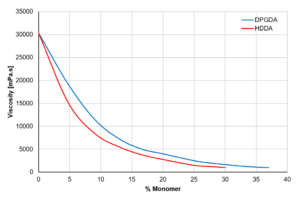
The reactive diluents, HDDA and DPGDA, were added to UA 1 in various weight ratios to determine the effect that changing the reactive diluent concentration has on formulation viscosity. This relationship is shown in Figure 1. Similar studies were completed with the reactive diluents and UA 2. This was done to determine the appropriate weight ratio to yield a viscosity of 1 Pas.
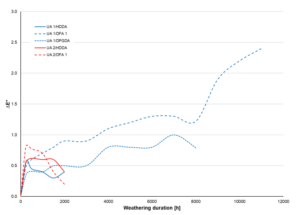
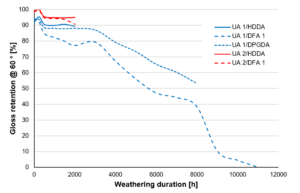
Figures 2 and 3 show the 60° gloss retention and change in color (ΔE*) results of clear coat films without UVAs or HALS, respectively. Films prepared with HDDA as the reactive diluent failed at approximately 2,000 hours, regardless of the urethane oligomer used. Clearcoat films prepared from DGPDA or DFA 1 and the flexible urethane oligomer UA 1 weathered at least an additional 6,000 hours before failing.
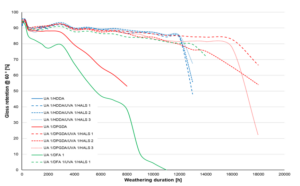
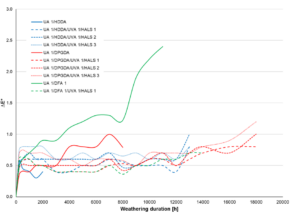
Figures 4 and 5 show 60° gloss retention and ΔE* results of clear coat films with and without UVAs or HALS using UA 1 as the urethane oligomer. Weathering results were improved significantly for films prepared with HDDA as the reactive diluent and containing a UVA and a HALS with coating integrity lasting at least an additional 10,000 hours or so before failure. Clearcoat films which were prepared from DGPDA, the flexible urethane oligomer UA 1 and containing a UVA and a HALS could be weathered to 18,000 hours.
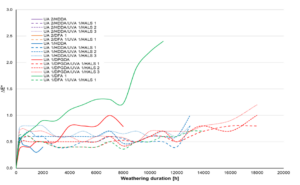
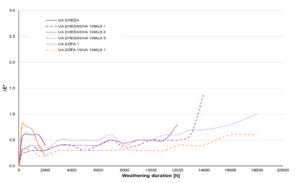
Figures 6 and 7 show the 60° gloss retention and ΔE* results of clear coat films with and without UVAs or HALS using UA 2 as the urethane oligomer. Weathering results were significantly improved for films prepared with HDDA as the reactive diluent and containing a UVA and a HALS with coating integrity lasting at least an additional 10,000 hours or so before failure. Clearcoat films prepared from DFA 1, the hard urethane oligomer UA 2 and containing a UVA and a HALS can be weathered to 18,000 hours with outstanding results.
The incorporation of UV absorbers and HALS into photocurable coating formulations requires careful selection to ensure the coating cure is not negatively impacted and the coating achieves the expected level of performance. The weathering resistance of UV-curable clearcoats can be improved significantly by using both the correct light stabilizer package as well as optimized photoinitiator combination. Additionally, it has been shown that the selection of the UV-curable oligomer and reactive diluents can have a significant impact on the weatherability of the cured coating films.
Conclusion
The exterior weathering resistance of UV-curable formulations can be improved significantly by using both the correct light stabilizer package as well as an optimized photoinitiator combination. No light stabilizer package is complete without the correct HALS and UV absorber package. High-performance photoinitiator combinations involving BAPO and a UV absorber based on hydroxyphenyl-s-triazine (in combination with HALS) are well suited to achieve both through-cure and extreme light fastness. UV-cured clearcoats show both improved gloss retention as well as a lower change in color. The overall performance characteristics, including lightfastness of UV-cured coatings, also can be improved by the appropriate selection of the UV-curable components used in the resin system.
References
- Schirmann, M. Dexter, “Light and Heat Stabilizers for Coatings” in Handbook of Coating Additives, Calbo, L.J., editor, Marcel Dekker, Inc., 1987, 225-268.
- J. Heller, H.R. Blattmann, Pure and Applied Chemistry 30(1972), 145.
- Berner, G. Dexlex, E. Schoof, XV FATIPEC-Congress Amsterdam 1980, Congress Handbook Vol. II, 61.
- Valet, A. Braig, “Light Stabilizers for Paints”, ISBN 978-3-86630-128-3, C.R. Vincentz Verlag, Hannover, Germany, 2017, 45-128.
- Studer, C. Lordelot, T. Jung, K. Dietliker, U. Lehmann, P. Simmendinger, E.V. Sitzmann, RadTech Proceedings 2008.
- R. Kaspers, C. Szewczyk, S. Megert, W. Peter, L. Cressy, D. Rogez, and E. V. Sitzmann, Radtech 2002 North Am. UV/EB Conference Proceedings (2002).
- Peter, S. Megert, D. Rogez, and E. Sitzmann, European Coatings Journal (2002), (11), 14-18, 21.
- Kimpel, E. Sitzmann, and M. Wood, American Coating Conference Proceedings 2018.
- V. Crivello and K. Dietliker, Photoinitiators for Free Radical Cationic & Anionic Photopolymerization, John Wiley and Sons/SITA Technology Ltd., London, 1998.
- V. Sitzmann, W. Peter, D. Bramer, J. Jankauskas, G. Losapio, J.-P. Wolf, S. Huguenard, Technical Conference Proceedings – UV & EB Technology Expo & Conference, Charlotte, NC, May 2-5, 2004 (2004), 874-891.
- M. Spinu, E. V. Sitzmann, K. O. Sass and K. P. Milks, Paint and Coatings Industry, 27, 2011/02/01.
- Challener, Coatings Tech, October 2016, Vol. 13, No. 10.
- Jung, A. Valet, RadTech Report, November 2001,30-35.
- Schwalm, “UV Coatings: Basics, Recent Developments and New Applications”, ISBN -13 978-0-444-52979-4, Elsevier Science, 2007, 102.
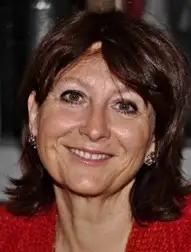 As a technical expert with 31 years of experience in coatings, Delphine Kimpel, BASF SE, is responsible for the global application development for light stabilizers, which comprises the technical support of existing products in the EMEA region, and the development of new products and new applications outside the traditional coating industries. Previously, Dr. Kimpel has held positions in technical management of industrial and decorative coatings, coating testing and evaluation for commercial launch and UV-curable systems for furniture and flooring, all with Ciba/BASF. Prior to joining Ciba, she developed new automotive OEM waterborne primers for Axalta in Wuppertal, Germany. She has numerous patents and technical publications and holds a Ph.D. in polymer chemistry from University Louis Pasteur in Strasbourg, France.
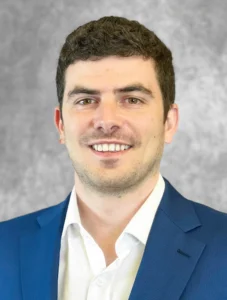 Jonathan Wattras is a technical specialist for BASF Resins, supporting the energy-cure and waterborne wood-resin portfolios. He has been with BASF for over three years and has worked in the Industrial Coatings industry since 2015. He holds a B.S. in chemistry from Allegheny College and an MBA from Wake Forest University.
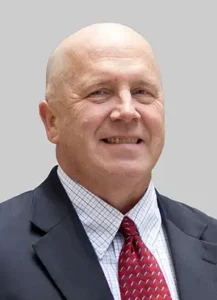 Mervin Wood Jr. is part of BASF’s Formulation & Performance Additives Team based in Charlotte, North Carolina, and has 38 years in the coatings industry. As a technical expert, he is responsible for technical support of UV absorbers, light stabilizers and antioxidants in coatings & adhesive applications for the NAFTA region. Previously, Dr. Wood has held positions in process development, coatings research, toll manufacturing and intellectual property management, all with Ciba/BASF. He has over 80 US patents and 20 technical publications. He holds a B.S. in chemistry from the University of Kentucky and a Ph.D. in synthetic organic chemistry from Emory University.