


By RadTech and UV+EB Technology staff
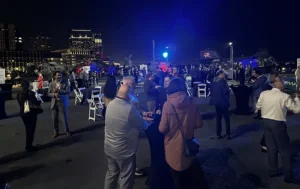 The BIG IDEAS for UV+EB Technology Conference was held aboard the historic USS Midway Aircraft Carrier & Museum in San Diego, California, on March 2-3, 2026, offering RadTech members thought-provoking discussions and engaging, behind-the-scenes, eye-opening tours. This evening conference brought together leaders in photopolymer chemistry, advanced manufacturing, coatings, energy, materials science, additive manufacturing and DefenseTech to explore the breakthroughs shaping the future of UV and EB curing. Optional daytime tours were offered to Taylor Guitars, Label King and Firestorm Labs.
 As Radtech President Mike Bonner said in his introductory letter for this issue of UV+EB Technology, “If you weren’t there, I don’t know what you possibly could have been thinking.” This magazine feature provides just a taste of the conference sights and content.
BIG IDEAS in DefenseTech
This panel featured Ian Muceus, Firestorm; Jake Windle, Harpoon Ventures; Ben Wynne, Intrepid Automation; and Danny Piper, NewCap Partners.
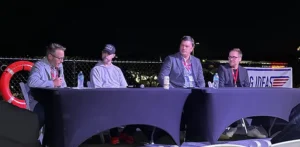 Ben Wynne, on challenges in using additive manufacturing in defense applications:
There is an incredible need across the military for spare parts. More importantly, and I think this is key when we talk about materials, the parts need to comply and conform to a certain regulatory baseline. So, looking at castings vs. metal printing, for example, when I make a polymer pattern that goes through a conventional casting process, the metal that ultimately becomes that part is from the same supply chain that it has been from for decades. That enables us to keep all the regulatory qualifications intact.
So, there are a lot of interesting things we can do with geometry and additive as a way to enable new design freedoms, but I think what’s needed right now is to create a supply chain that’s resilient and can adapt. And I think that’s where a lot of people have failed at 3D printing – when you come with new materials and you get stuck in this qualification problem.
Industrial Inkjet in Automotive Manufacturing
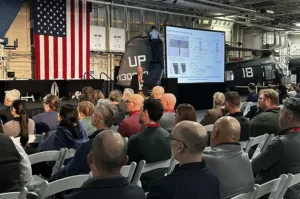 Chris Seubert, Ford Motor Co., presented “Precision Fluid Delivery in Automotive Manufacturing: Leveraging Industrial Inkjet Technology.” In discussing some of the current application challenges in using industrial inkjet technology for paint applications, he explained:
When it comes to challenges, when we go lower viscosity and we’re printing on something horizontal, that’s great because gravity is our friend and it’s leveling everything out. As soon it isn’t horizontal, we start having issues. So what we really would like is a non-Newtonian system where something is low viscosity at high shear rates, because that’s gonna give us good ejection. But when it’s landed on the vehicle and starting to evaporate solvent, we really want it to have a higher viscosity profile because we don’t want it to sag. But we also want it to flow enough so we don’t have visual defects from overlap and other issues. So, this is a very big balancing match, and that’s what paint suppliers are struggling with right now.
TPO Under Pressure: Formulating Beyond a Targeted Photoinitiator
 This panel discussion was led by Paul Share, Advanced Materials Design LLC, and featured panelists Steve Postle, BCH; Alex Haring, Formlabs; David Biro, Sun Chemical; and Rohit Sabnis, Keller and Heckman.
Alex Haring, on the role of TPO in his company:
We’ve been formulating away from TPO. We have 40-plus SLA materials now that we sell, and I think we still have two that use TPO. That’s both because we’re worried about compliance and what’s going to happen in Europe, but also we are hearing it directly from our customers. I think our customers are a little bit different because we work with people who are going to be putting their printers in an office setting and working directly with the material, so they either are asking the question directly or they have an EHS department that restricts TPO from coming in. So we get pressure from that, and it definitely pushes us to move away from it.
A Look Inside Label King with Founder Robert Parker
By Cara Bommarito, RadTech
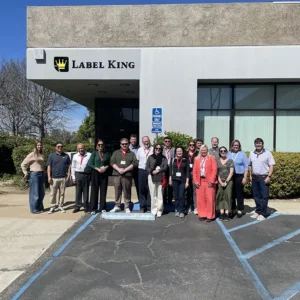 Visiting Label King was particularly meaningful because printers represent the point in the UV/EB supply chain where all the technologies converge. Resins, inks, lamp suppliers and brand owners all come together in one location. Owner Robert Parker founded the company 24 years ago and has seen significant growth ever since, as Label King and other UV printers are key components of the printing and packaging industry.
What was your first impression of UV printing?
Parker: My first impression of UV printing was that it was messy. Our first press was an old, used press, and the system is probably 40 years old now. Therefore, the ink system was inefficient and very challenging to clean. Once we managed to make that older unit work and also started transitioning to newer systems, we truly began to see the numerous advantages of UV printing. Since then, we have fully converted to UV, and it has made a difference in our operations.
In terms of sustainability, does UV cure have noticeable advantages?
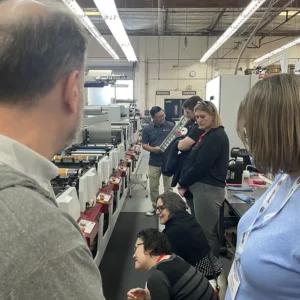 Parker: When it comes to sustainability, one of the biggest benefits is energy efficiency. Removing the blower reduces energy use and frees up valuable manufacturing space. The set-up and teardown process also is much smoother, and the inks are more stable and easier to work with. Another major plus is that the presses run much quieter, which makes a big difference for our operators at Label King. Overall, UV technology continues to advance and deliver great improvements for our industry.
What advancement would you like to see for UV cure in the printing space?
Parker: I’d love to see UV curing advance to a point where UV LED can be used for flood coats. That capability would make UV curing even more versatile in the printing industry.